Quick, Set the Gap (in transition)!
521,139 transition sets reveal which setting targets and attack types are most effective.

Part 6 in the "What Really Wins Sets" Series
Howdy folks! Welcome back to the "What Really Wins Sets" series. In my last post, I dug into the first link in the Dig-Set-Kill chain and showed that where your team digs the ball matters far more than how often you dig it. Today we're moving one link further in that chain and looking at setting in transition.
First, I want to warn you that this blog post turned out a LOT longer than I anticipated. In fact it's so long, I've split it into three separate posts on the topic, this being the first. So you might want to read this one in multiple sittings. It definitely took me many sittings to write it.
For this first post, my main focus is on answering one question:
*When the setter is setting in transition, which setting targets and attack types are most effective?*
In the subsequent posts I'll dig into a bunch of related questions:
When the setter is pushed farther off the net in transition, how do those targets and attack types change?
When the libero is setting in transition, what setting targets and attack types are the most effective?
Are there locations on the court where it's more effective to have your libero set rather than your setter?
To answer these questions, I fired up my data pipeline and Claude Code and pulled every transition Dig-Set-Attack sequence from the 2025 NCAA DI. That's a lot of data, 521,139 transition sets to be precise. Many of the patterns are pretty clear. Some of them surprised me.
A quick refresher on zones and subzones
For those of you who aren't familiar with VolleyStation, DataVolley or other volleyball stats products, all the heatmaps in this post divide the court into 36 cells: 9 top level zones, each split into 4 subzones labeled A, B, C, and D. The labeling looks like this:
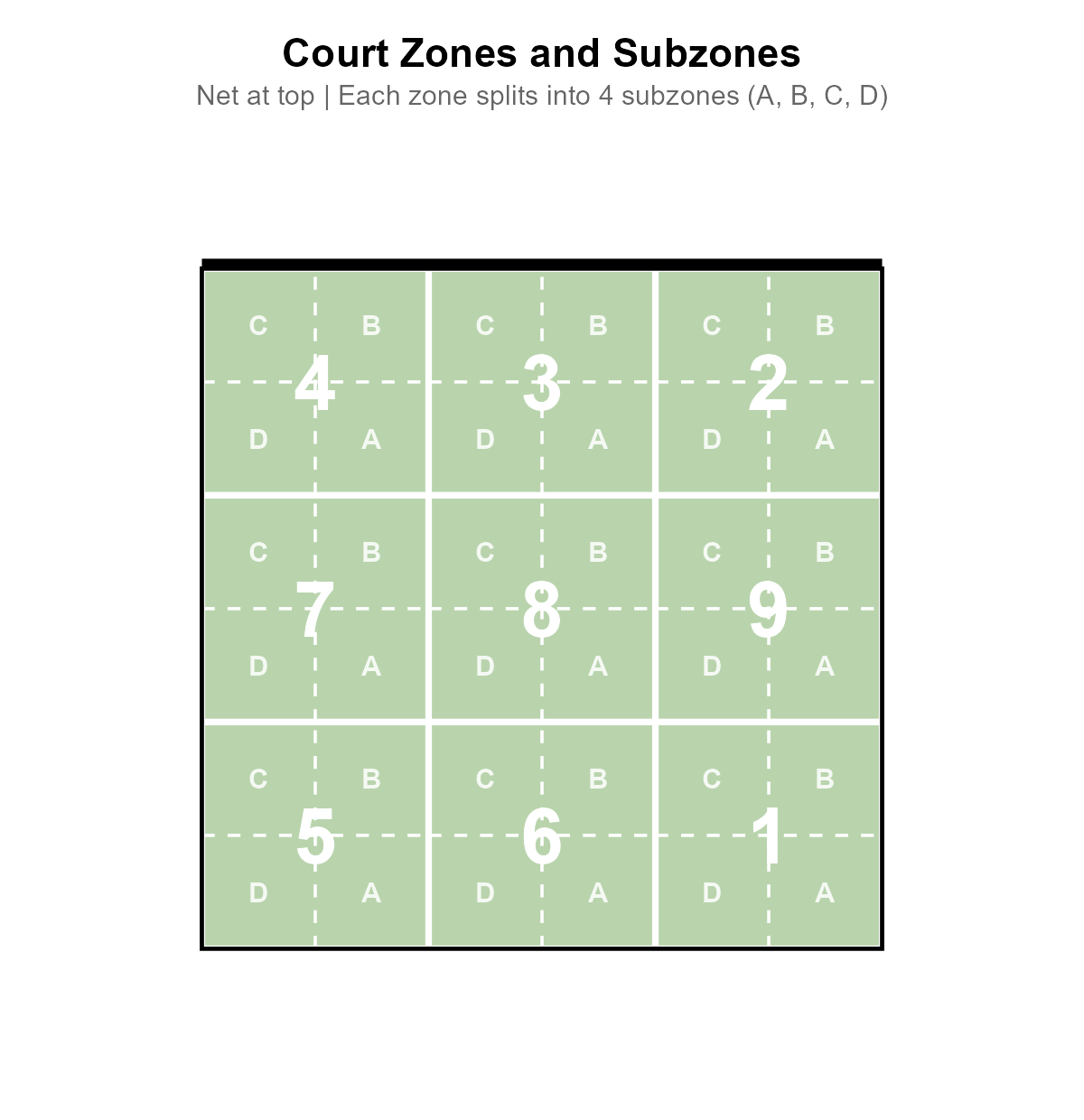
When I mention subzone "3C", I'm referring to the front-middle area of the court (zone 3), and the top-left quadrant within that zone (subzone C). "4D" means the front-left area of the court (zone 4), bottom-left quadrant (subzone D).
Where Should The Setter Set to in Transition?
Let's start with the easy one. When your setter is setting in transition, what are the most effective locations to set to?
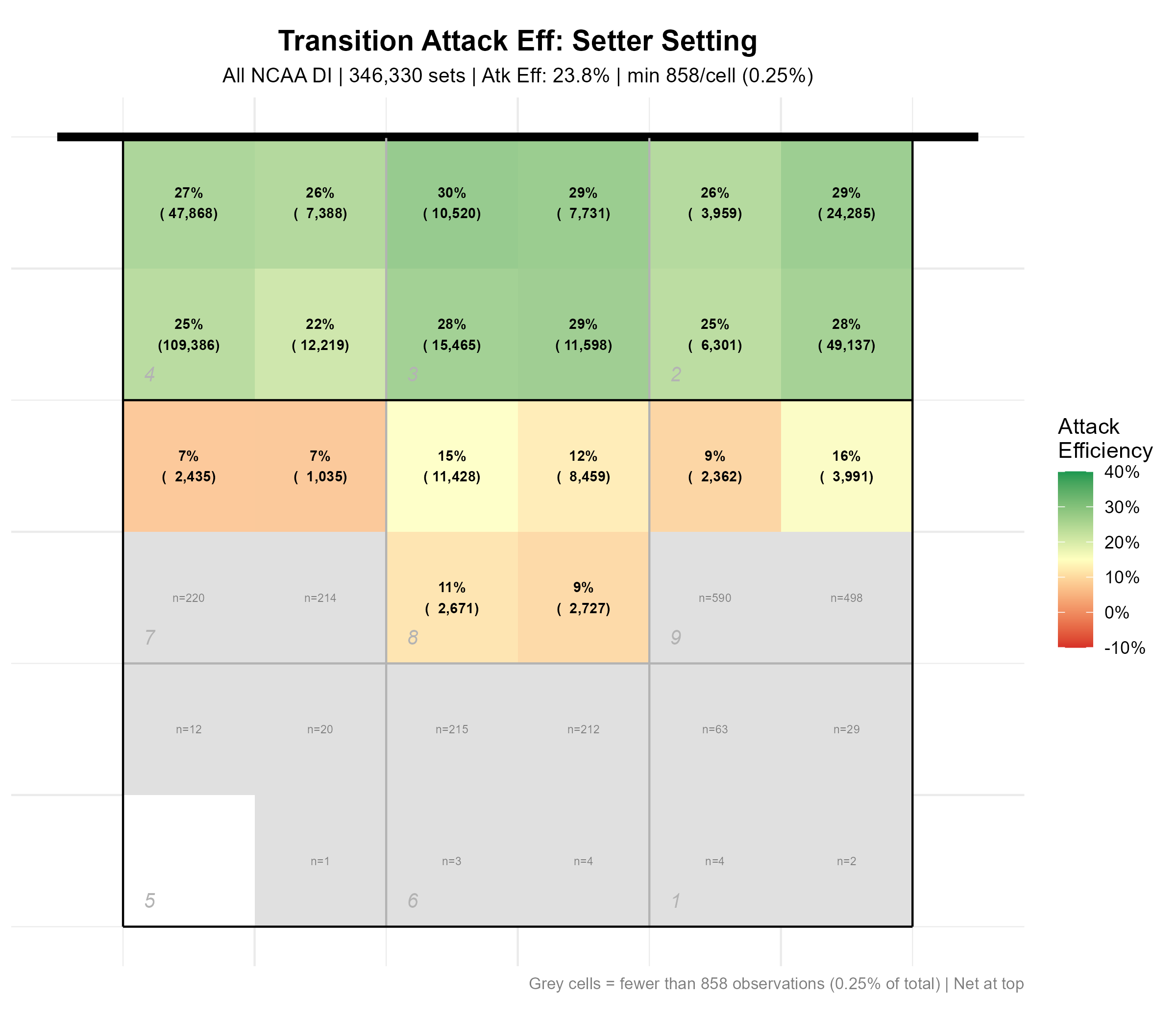
This is the transition setting heatmap for NCAA Women's DI in 2025. Each subzone is colored based on the average attack efficiency % of the subsequent attacks of all sets that were set to that location in transition by a setter. Greener is better, redder is worse. Inside each cell you'll see two data points: resulting attack efficiency on top and the number of attacks in parentheses underneath it.
If you've been coaching for any amount of time, none of this surprises you. It's pretty much the accepted gospel. But it's nice to see the data confirm it so cleanly:
Attacks in the middle (3C & 3B) are the highest-efficiency at 30% and 29%.
Right-side attacks (2B & 2A) are right behind at 29% and 28%
Left-side attacks (4C & 4B) round out the top tier at 27% and 26%.
The far left-side (4C & 4D) is where setters set to the most in transition (45% of sets).
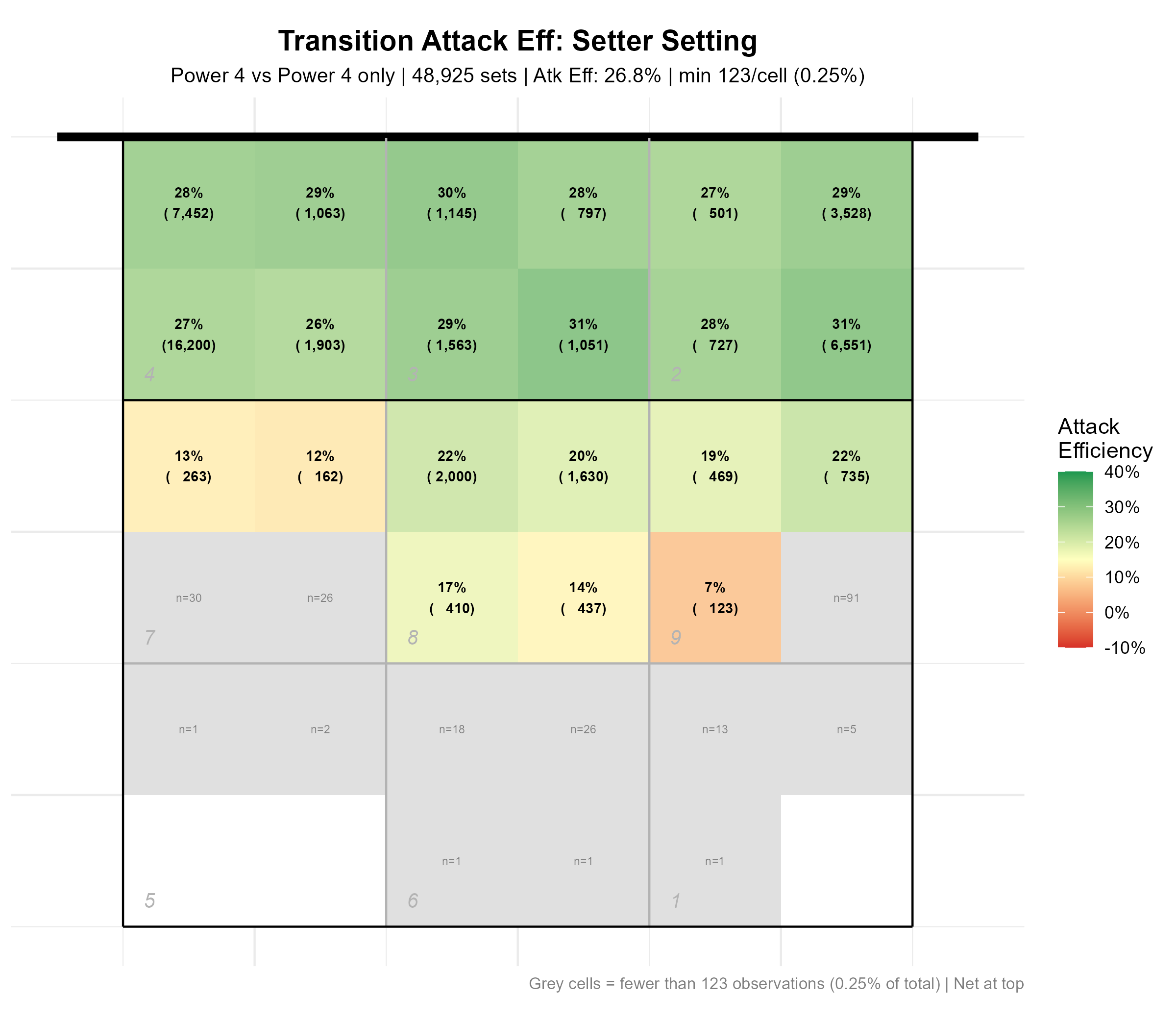
This next heatmap is using the same approach, but the data has been filtered to use only 2025 matches between P4 teams. As you would expect the attack efficiency numbers go up across the board and the patterns are pretty similar. Interestingly, the attack numbers in the middle of the court do not go up as much as those in the other zones.
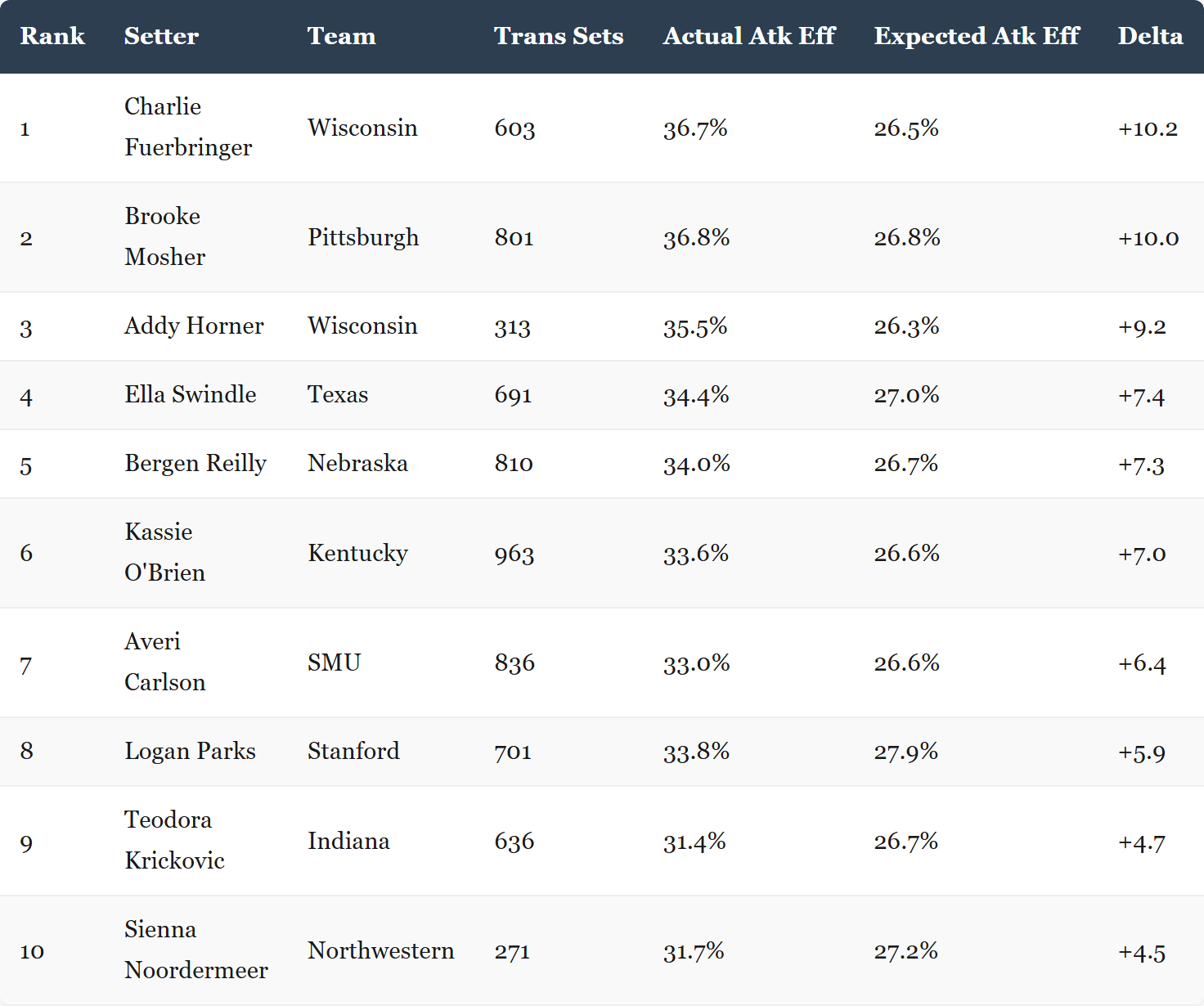
Looking at these heatmaps I wondered which setters were making the best set location choices based on expected attack efficiency % (i.e. using the heatmap values) and which teams were exceeding those expected %s.
You can see the results of that analysis for the Power 4 matches below.
The list is pretty much what you might expect; the best setters on the best teams do both really well. I was excited to see #10 on the list though. Based on this data, Sienna Noordermeer is making some very effective choices in transition. I've never seen her play but now I definitely want to watch her during the 2026 season.
After reviewing this data and the heatmaps I wanted to understand which attack types these setters were setting. Which ones were the most efficient in each of these zones, particularly in 3C & 4B (quick attacks by middles or inside attacks by pins?),3D & 3A (quick attacks or BICs?) and 2A & 2B (right side attacks, slides or D-Balls?).
Setting middle quicks in transition
To start answering these questions I filtered the all DI heatmap to only the transition attacks that are tagged as being quick middle attacks.
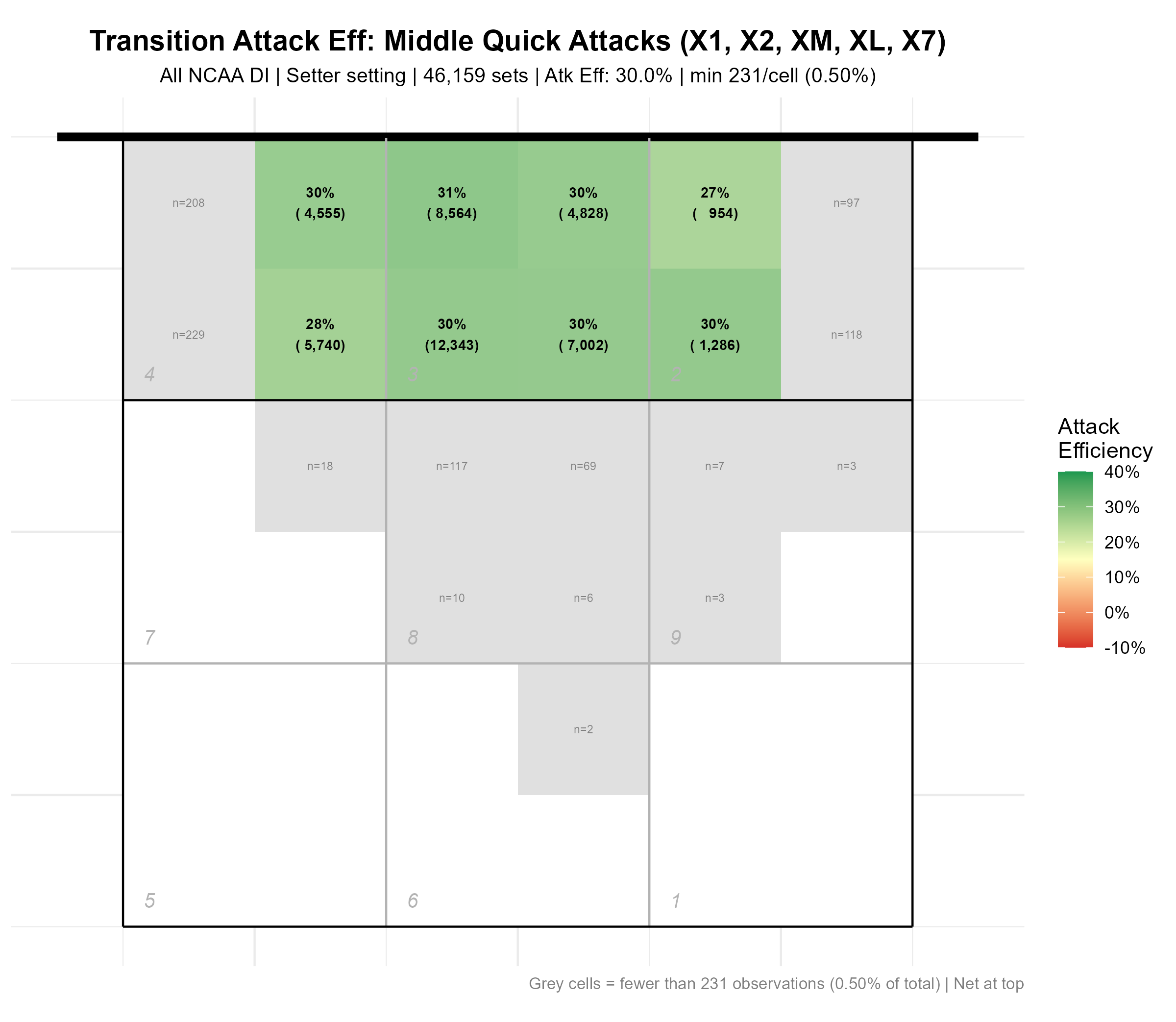
This heatmap is showing the results for every quick attack set in transition in NCAA DI 2025, a total of 46,159 attempts with an attack efficiency of 30%. If you can set your middles in transition, you get some of the highest attack efficiencies available. The middle quick attacks are the most productive transition attacks in NCAA DI.
When I reviewed this data, I was actually a little surprised the attack efficiency numbers weren't even higher. Shouldn't an elite middle blocker have an attack efficiency better than 30%? So I added the P4 match filter again to see what the results were when Power 4 teams play each other.
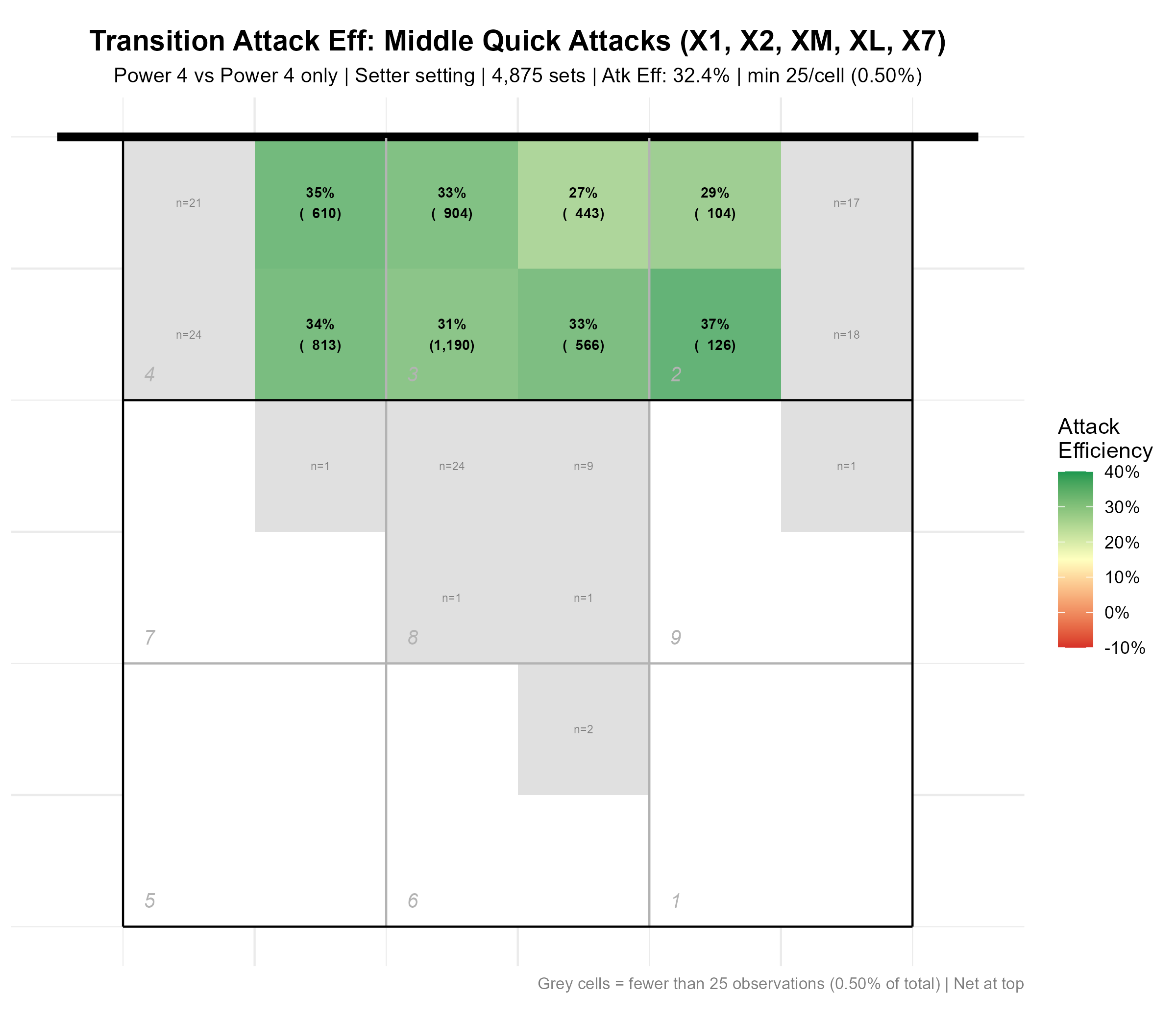
These numbers were starting to look more like what I expected. P4 setters and middles run transition quicks at 32% efficiency overall, two points above the NCAA DI number.
But there are some pretty interesting things going on in this data. Look at subzones 4B & 4A. Those are sets to middles running gap attacks. Those attack efficiencies combined are just over 34%, meaning that in P4 competition, this is the single most effective transition attack option available.
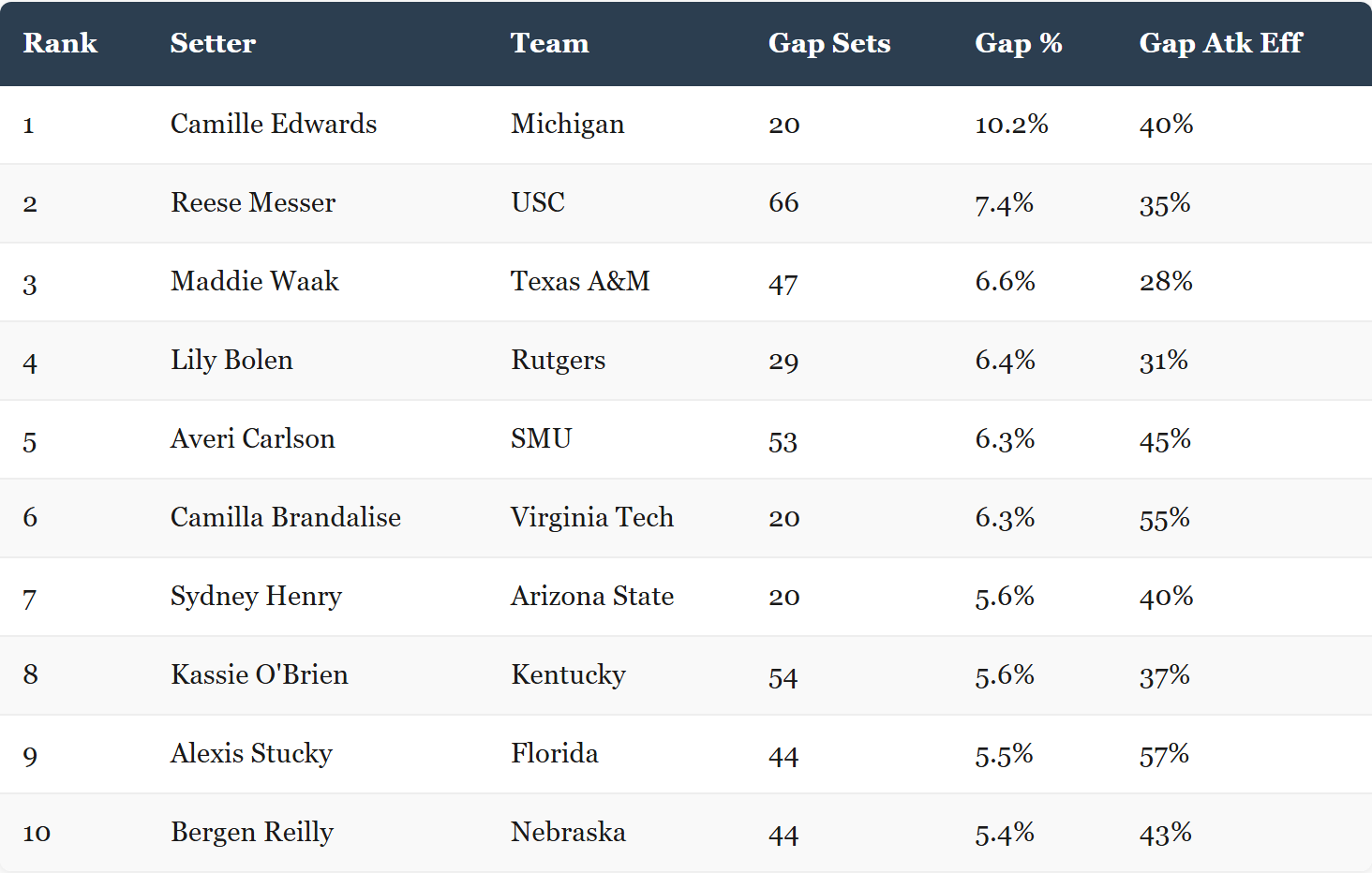
Note: Gap % in the table above is the percentage of total transition sets that were set to the gap
As you can see from this table, some teams have figured this out and are taking full advantage of the opportunity. Some of these attack efficiency %'s are pretty impressive (way to go Florida and Virginia Tech!).
There's also something interesting going on in Zone 2. Those are middle-quick attacks (i.e. not slide attacks, I'll discuss those later) quite a ways over on the right side. And the attack efficiency is a combined 32% in front of the setter and 31% behind the setter. Watching a sample of clips of these attacks, what I learned is that most of these are quick attacks that are run relative to the setter's position rather than to a fixed point on the court. When the dig pushes the setter into zone 2, these middles go where the setter goes.
Coaching takeaway: Getting good at setting quicks in transition can significantly improve your attack efficiency, especially if your team can set the gap. The good news is that this is low hanging fruit even if you are not a Power 4 team. I've made setting the gap in transition a focus area for my U15 club team this year and it's become one of the most effective plays they run.
Setting BICs in transition
The BIC (Back-row Quick) is a mainstay of men's volleyball and is now being used in high level Women's volleyball as well. But as you'll see from this data, in NCAA Women's DI, at least in transition, the results are mixed. The DI attack efficiency of BICs in transition was only 18% on 13,387 attempts.
The volume (only 2.5% of all transition attacks) kind of tells the story. Many teams are hesitant to run this attack in transition and the attack efficiency numbers make it clear why. That said, some teams and some conferences run it more frequently and more effectively than others.
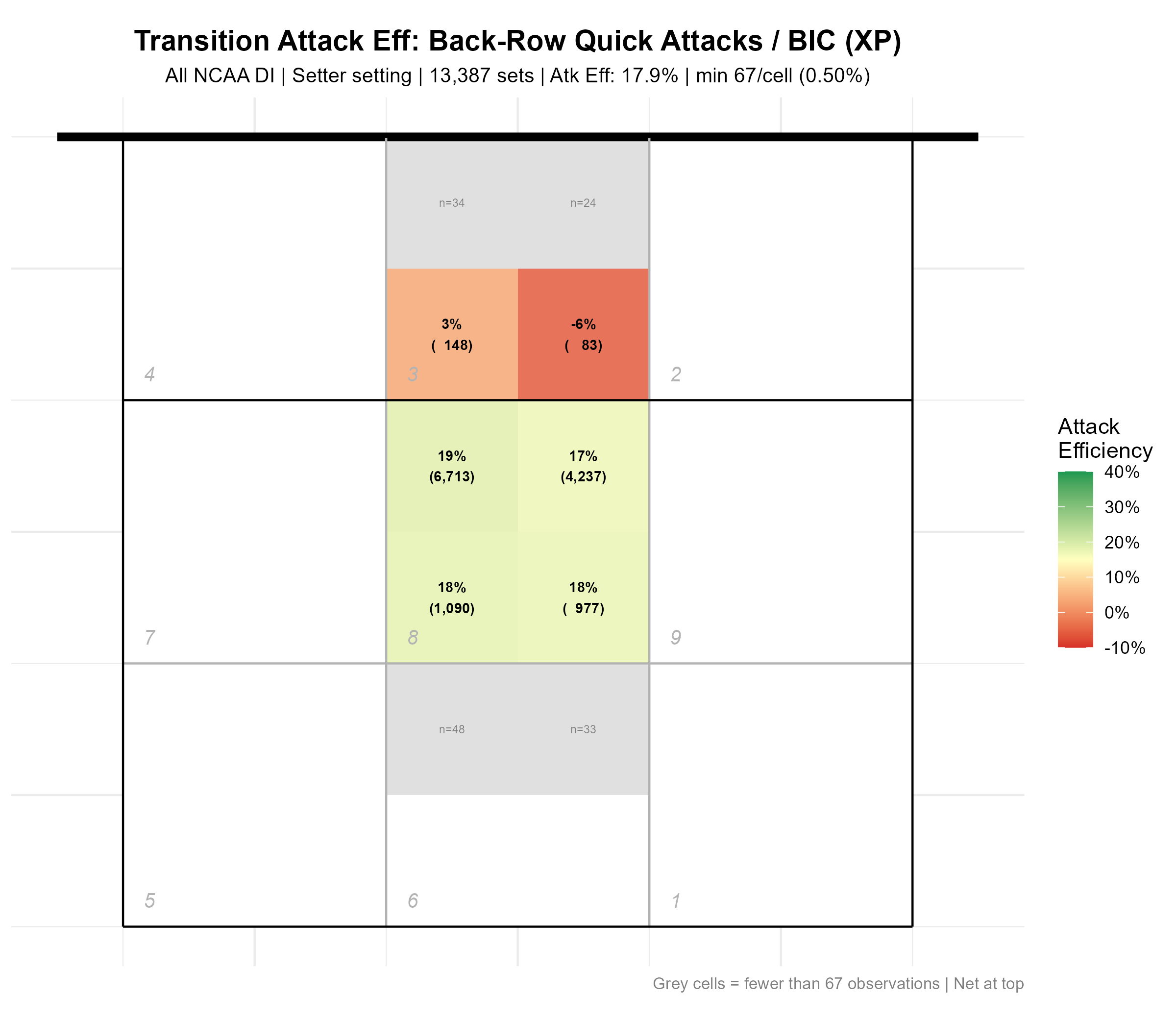
When you filter to only P4-vs-P4 matches BIC attacks in transition look a lot more promising. Transition BICs jump from 18% attack efficiency in all of DI to 24% in P4, and 26% when run them left of center. That is just about the same efficiency as the left side front row transition attacks (27%) in the Power 4, so for this group of teams, BICs are a good choice in transition.
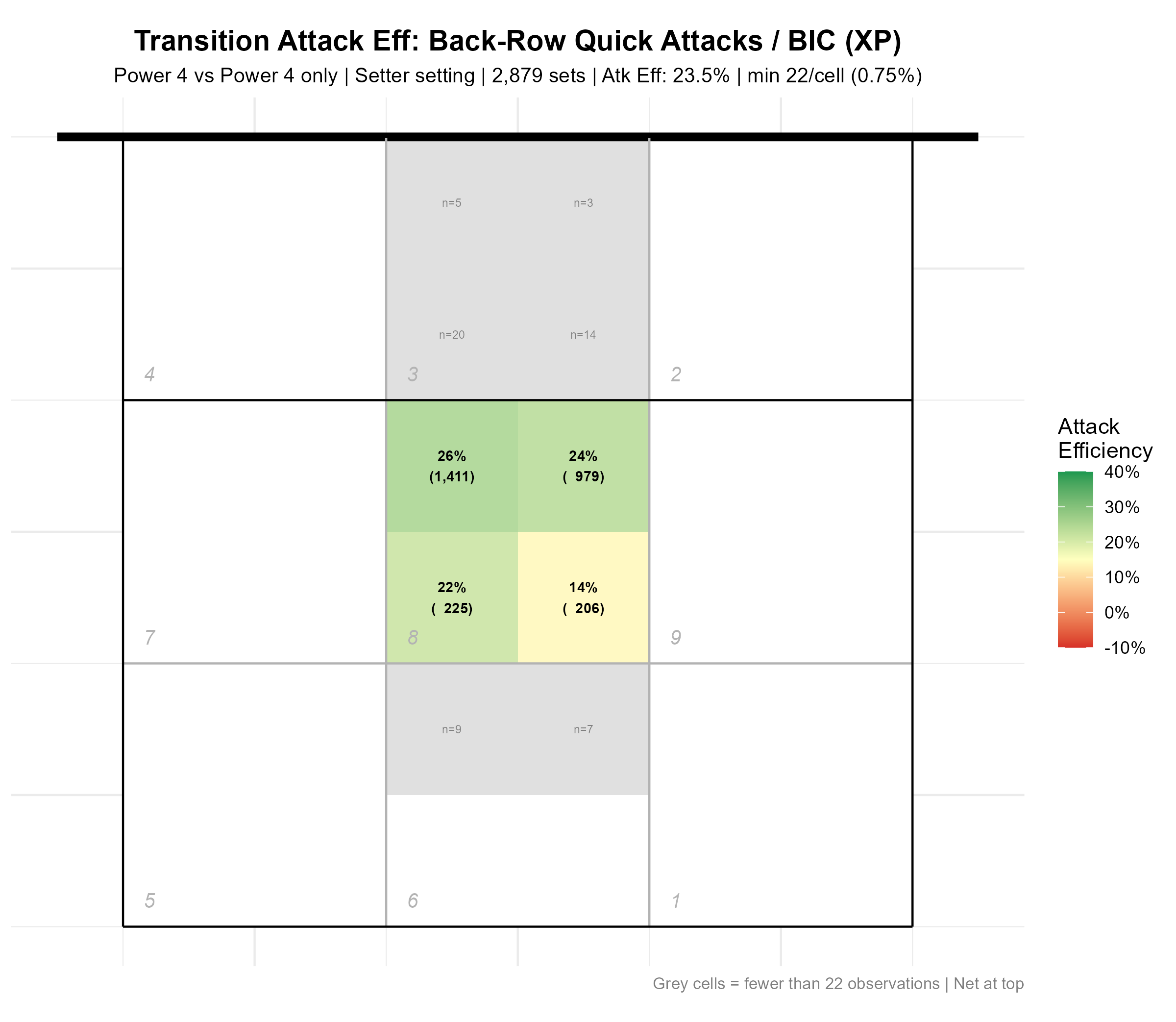
But it's good to remember that these P4 athletes are pretty elite and play the game at a very high level. To give you an idea of just how elite, here are the top 10 BIC attackers in P4-vs-P4 matches in 2025 (minimum 20 attempts):
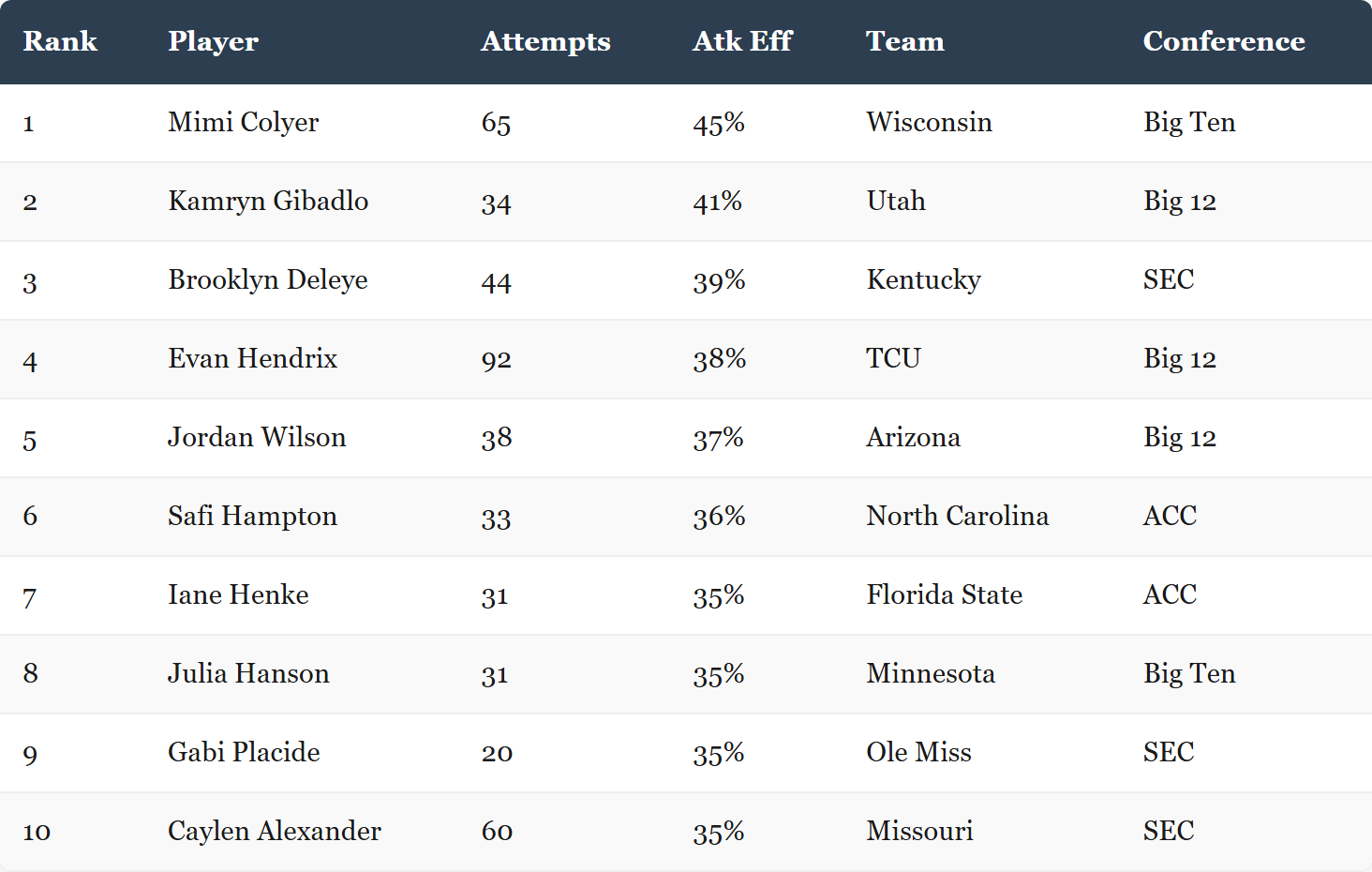
Luckily, the top 10 isn't the whole story. 35 P4 athletes hit 27% or better on BICs in transition against other P4 teams (with at least 10 attempts), so the volume of athletes who can execute an effective BIC in transition is meaningfully broader than just the volume leaders.
And the story is actually even broader than that. There are a lot of athletes in a lot of programs hitting BICs in transition with high effectiveness. The top 10 most effective non-P4 transition BIC attackers have attack efficiency numbers VERY similar to their P4 counterparts:
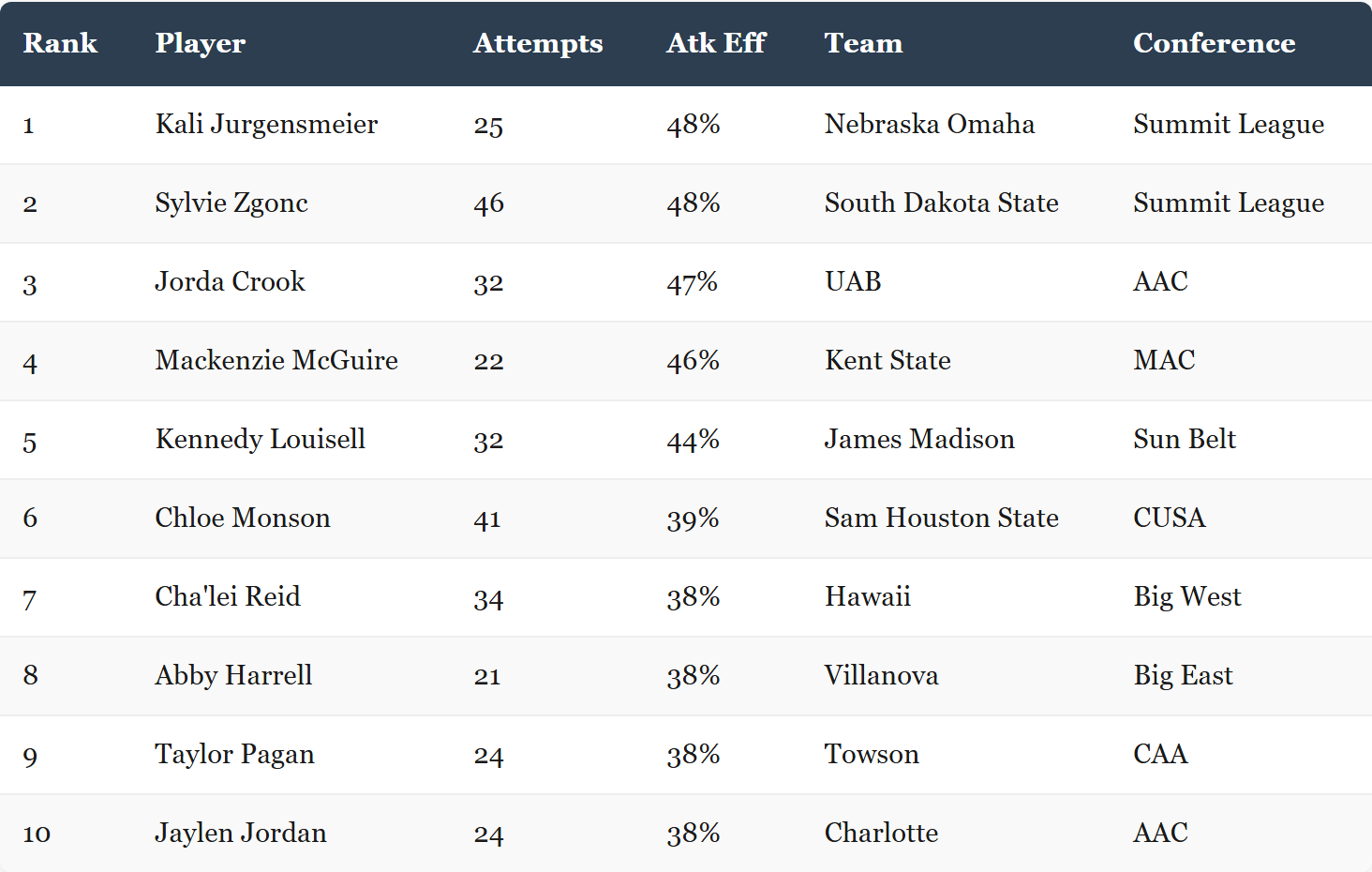
Encouragingly, 68 non-P4 athletes hit 27% or better on BICs in transition in 2025.
Net net: There are lots of teams and athletes that can run the BIC with high effectiveness.
Coaching takeaway: If you have a strong outside hitter on your team, you should consider training your setter and that outside to run BICs in transition. In many cases, they can be just as effective hitting the BIC attack in trans as they are hitting on the left. And if they get really good at it, they could be even more effective than your middles running quicks.
Setting the D-ball in transition
The D-ball is a right-side back-row attack, usually hit by an opposite. It is probably the single most important attack in international men's and women's volleyball but has never had much traction in NCAA Women's volleyball.
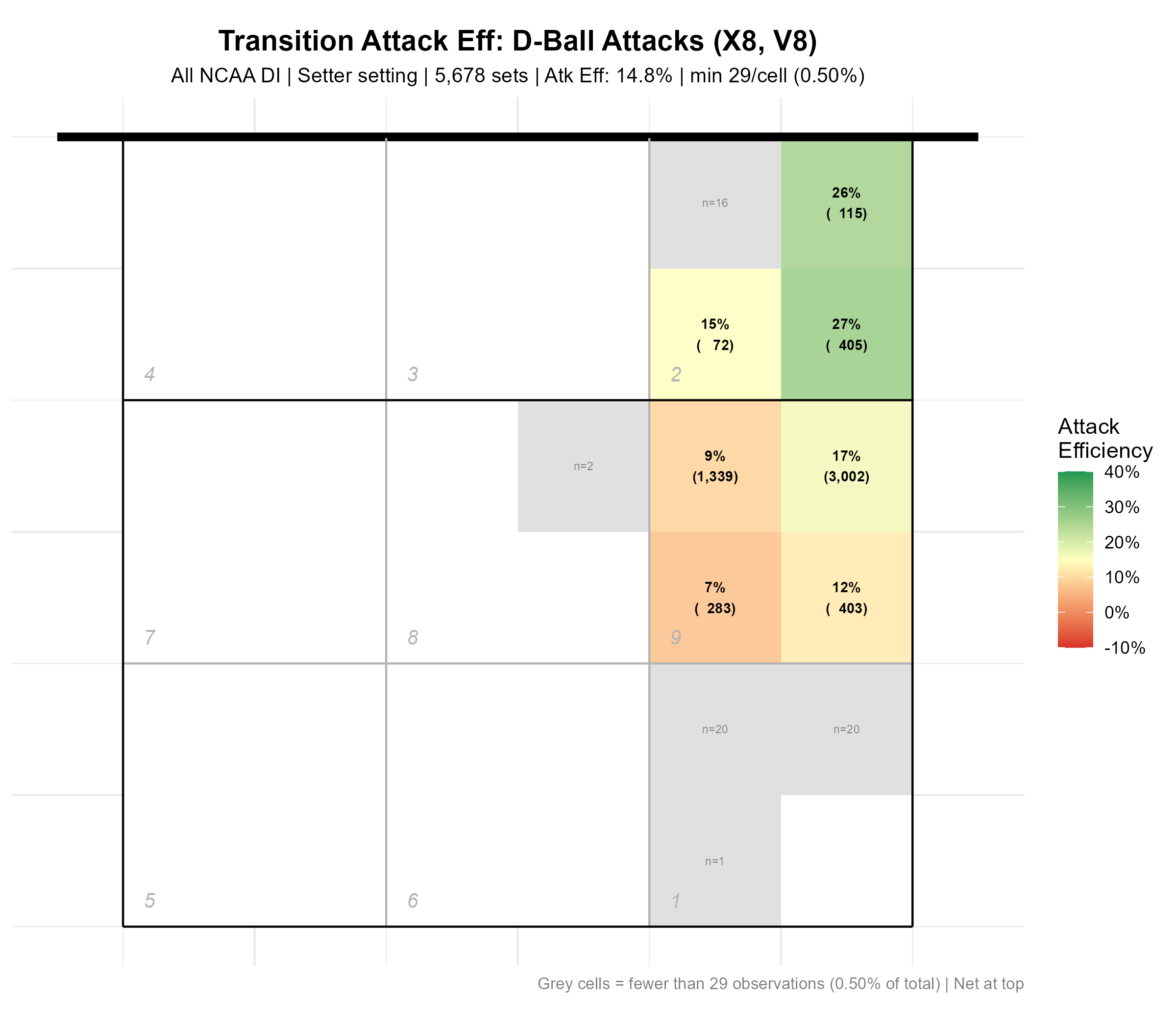
Across NCAA DI in 2025, transition D-balls result in a 15% attack efficiency on 5,678 attempts. That's the lowest attack efficiency and volume of these "non-standard" transition attacks (gap, BIC, D and slide). As evidenced by the very low volume, in the US at this level, D-balls are a specialty option for the small number of teams that have an unusually gifted right-side attacker.
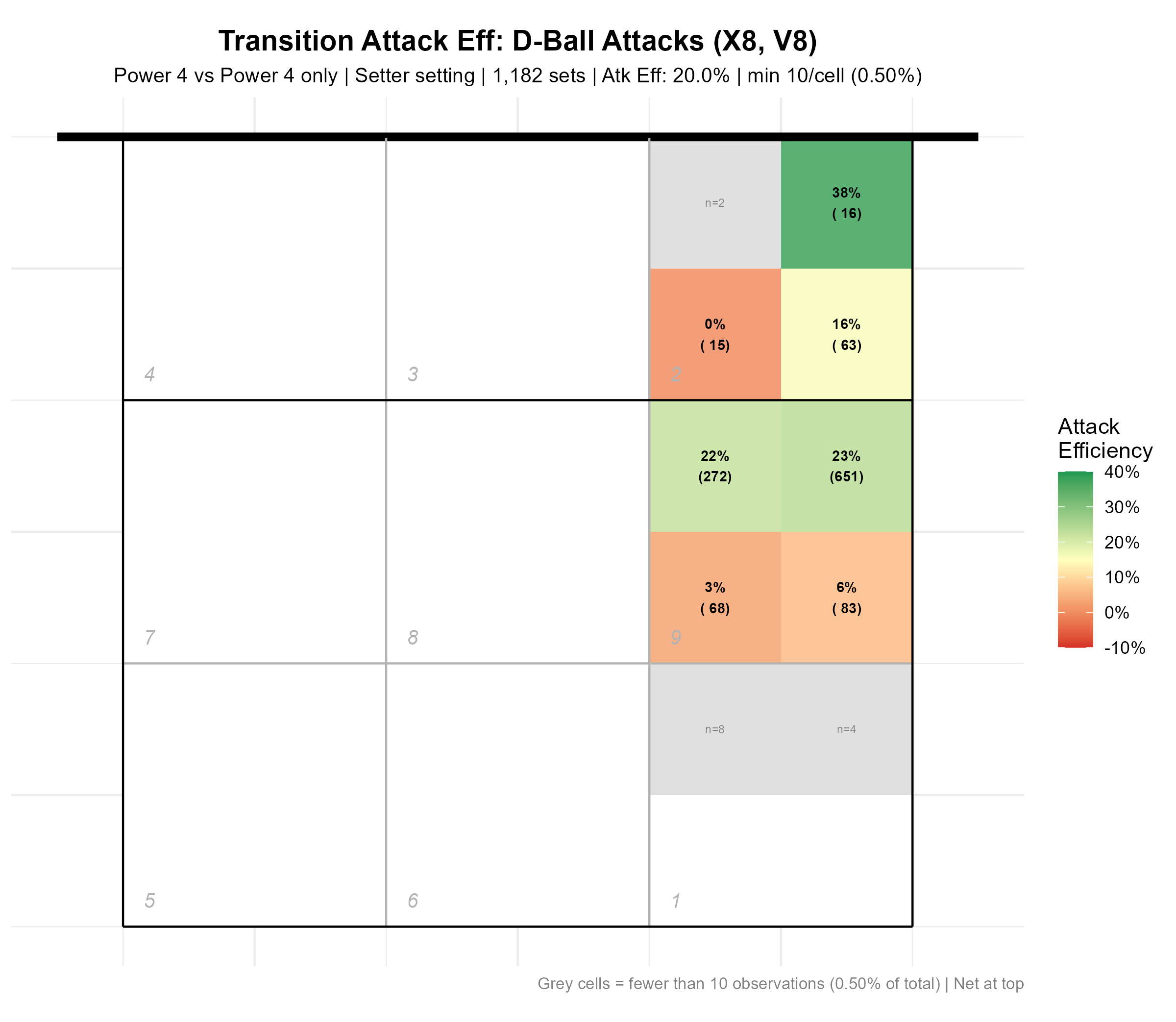
While Women's DI attack efficiency on D-Balls is only 15%, P4-vs-P4 jumps to 20% on 1,182 attempts, but that still isn't great. Even in the P4, the D-ball is a low-volume specialty attack (P4 teams run roughly one D-ball for every four BICs and one for every twelve quicks). That said, if you are one of the lucky few who have a back-row right-side who can rip the ball, the data shows it works against the best defenses in the country.
One note: You might be wondering what's up with cell 2B in this heatmap. I pulled a sample of clips from the matches that produced the 2B-coded D-balls, and they are D-ball attacks. Watching the clips, many times the attack contact point is hard to see - it's somewhere between 2A and 2B in almost every case. So treat the 2B and 2A D-ball cells as essentially one combined area.
Just how much of the elite D-ball volume is concentrated in a few specific athletes? I pulled every P4-vs-P4 transition D-ball in 9B (where most of the attack volume is) and ranked the hitters by attempts. The list is short, and the names tell the story:
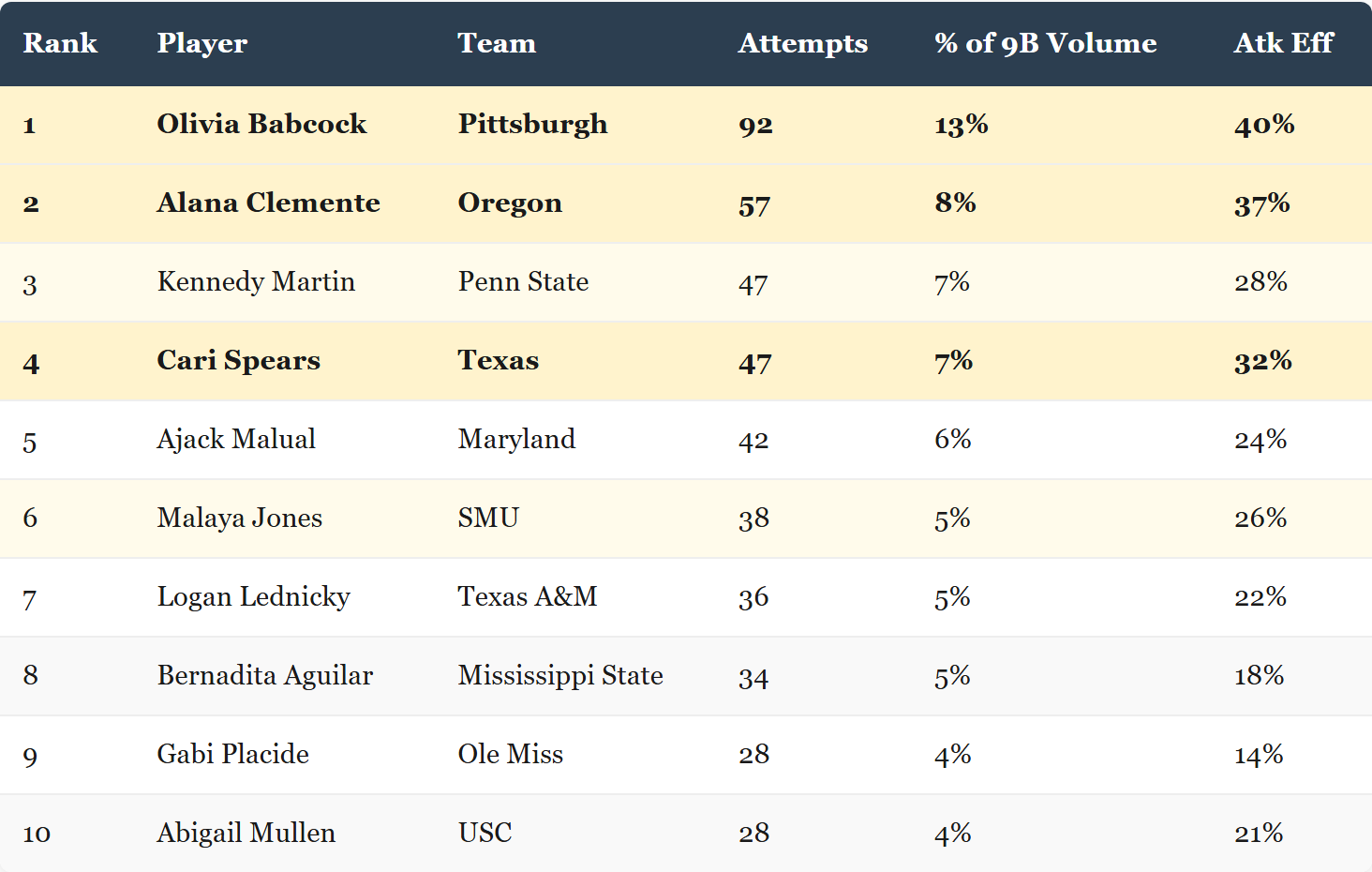
95 different DI athletes hit a D-Ball from this zone, but 62% of the volume comes from just the 10 athletes above. The number of teams using this option is tiny, and as you can see from the shading, the number of athletes who can hit this attack effectively is minuscule. The top four (Babcock, Clemente, Martin, Spears) are 34% of the entire cell between them.
Coaching takeaway: I have mixed feelings about this one. Clearly today, in the US, at the DI level, unless you have a truly elite opposite, your team should not run D-Balls in transition. That said, in women's professional volleyball around the world, this is a very normal attack that many teams run effectively. My take is that because the US women's volleyball community loves the slide attack, we don't train young athletes to hit a D very often. Thus there aren't very many athletes for college programs to recruit who are good at this specific attack. It may be up to my fellow club and high school coaches to decide if we want to change this going forward!
Setting slides in transition
Alternatively, in the US, slides attacks are very popular and as the data shows, a slide can be a very effective option in transition. A slide is a front-row middle blocker running behind the setter and hitting off one foot, usually finishing near the right antenna. Anyone who has watched women's college volleyball over the last decade has seen how dangerous a middle like Andie Jackson, Erika Sayer, Carter Booth or Dana Rettke can be running slides.
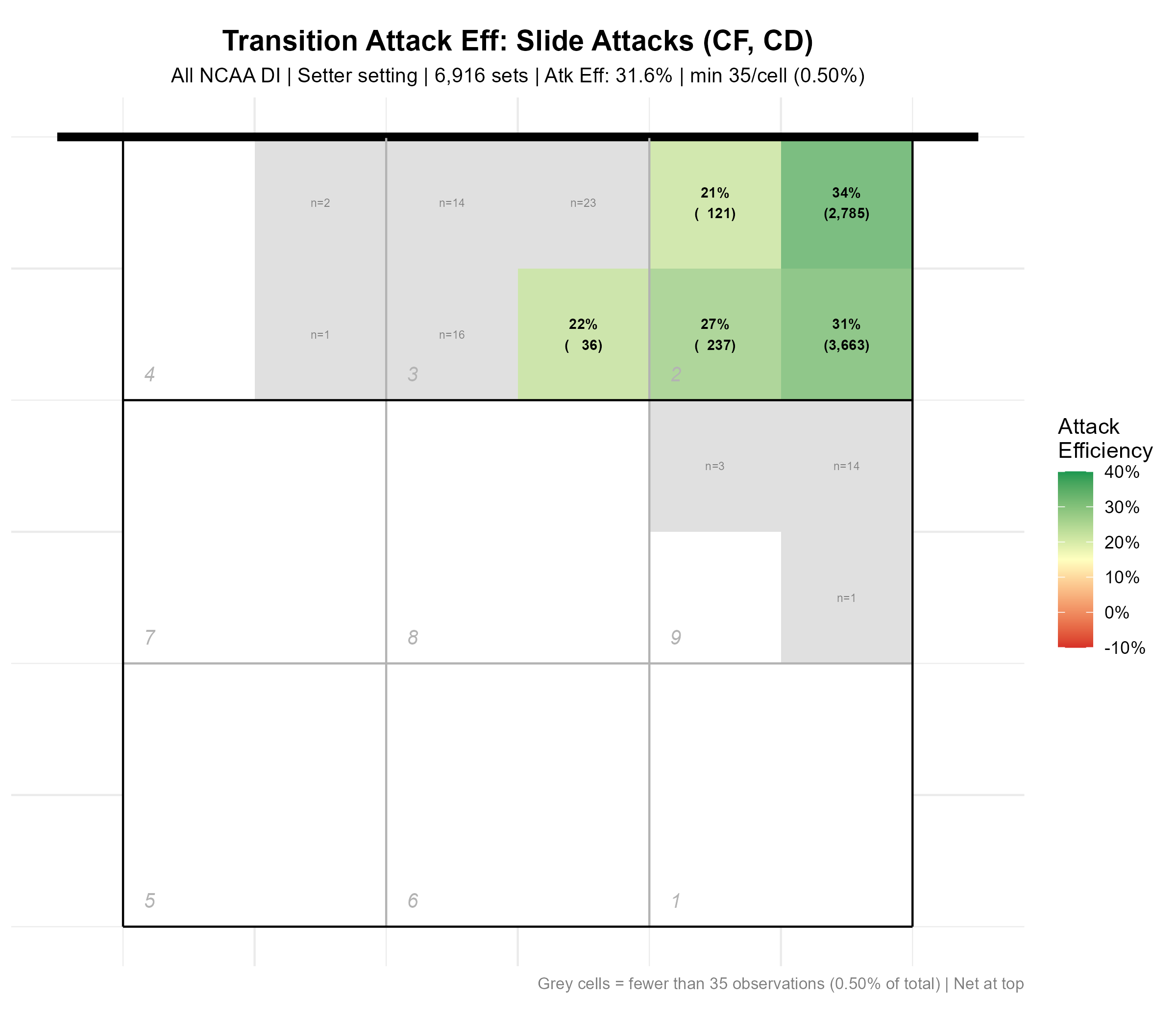
Across NCAA DI in 2025, transition slides are highly efficient with an average 32% attack efficiency but they are run surprisingly few times with only 6,916 attempts, only slightly more frequently than D-Ball attacks. I'm not sure why that is the case. According to these numbers, running a slide in transition is almost as effective as running a quick attack and it's significantly more efficient than any pin attack.
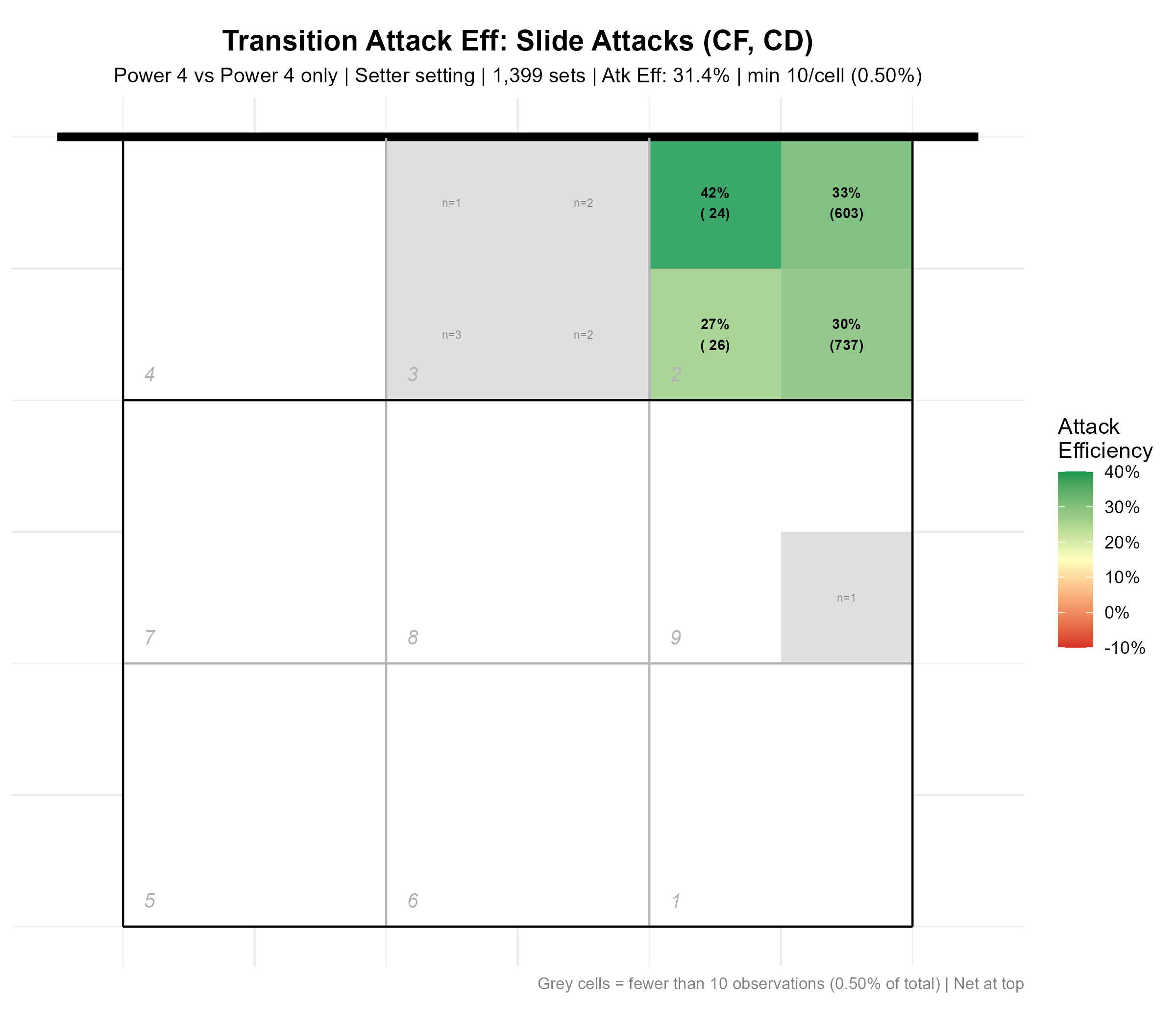
Interestingly, this is an area where when you filter to just Power 4 vs Power 4 matches, the efficiency number barely changes. P4 slide attackers hit at 31% on 1,399 attempts, essentially the same as the DI number. This is the only attack we've looked at in this section where the P4 efficiency is not higher than the overall DI baseline. My suspicion is that is because slides are an attack that many athletes in many programs can run effectively unlike D's.
Coaching takeaway: Slides are a great option in transition, nearly as effective as quick attacks in the middle and much more effective for a much larger group of teams and athletes than Ds. So if you aren't already teaching this, it's probably time to start training your setters and middles to run slides in transition!
What's Next
Now that we know what attacks to run and where they go, the next question is: how does the menu change when the setter gets pushed off the net? In my next post, I'll analyze all these locations and attacks separated out by how far the setter has been pushed off the net so we can see which locations and attacks remain effective and which should get taken off the menu.
Methodology note: This analysis uses every transition Dig-Set-Attack sequence from the 2025 NCAA DI season (521,139 total). "Setter" means the team's active setter (any player who took 20% or more of the team's sets, excluding liberos). "Libero" comes from the match metadata. The 36-cell subzone grid uses a minimum cell threshold of 0.25% or 0.50% of total observations to filter out scouting noise. The "Set Destination Quality" metric is computed by looking up the league-baseline attack efficiency at each subzone where a team's setter sets to, then averaging those values across all of the team's setter sets. Teams with fewer than 100 setter sets in transition were excluded from the correlation analysis.