Good Attacks Per Possession: One Simple Metric Your Whole Team Can Rally Around
A stat that is easy to track, easy to explain, and that every player on the floor can push in the right direction.

Howdy folks!
Today's post is something a little different. I'm going to walk you through a new metric I've recently started using that I'm quite excited about.
This past December at the AVCA Convention, I caught a talk by Lauren Bertolacci, the head coach of Indy Ignite and the Swiss Women's team. She said something in that talk that has been rattling around in my head ever since. She made a wonderfully simple claim: the most important thing when it comes to winning sets is the number of points you score yourself per hundred rallies. I love this kind of thinking. One clear idea, stripped of jargon, that a whole gym can rally around.
It sent me on a hunt. I wanted to find something similar to what Lauren had said that I could use with my team. To do that, it needed to be:
Simple to track, so we could track it in match or at practice on a white board.
Simple to explain to the team.
Something every player could contribute to improving.
Something that was largely under our control.
Something that had a large/significant impact on our chances of winning
After a lot of experimenting, I think I've found a metric that meets all these criteria and works really well: Good Attacks Per Possession.
Introducing Good Attacks Per Possession
The idea is about as simple as it gets. When the ball comes over the net to your team, how often do they turn it into a good attack? That's it. It's kind of volleyball boiled down to its essence.
I'm defining "Good Attack" broadly here: any kind of attack (a spike, a roll shot, a tip, a toss, etc.) that doesn't result in an unforced error. Then I'm dividing it by the team's total number of possessions. In essence, what percentage of the time that your team received the ball did they find a way to successfully pass/dig the ball up, set it and get an attack off that made the other team play defense?
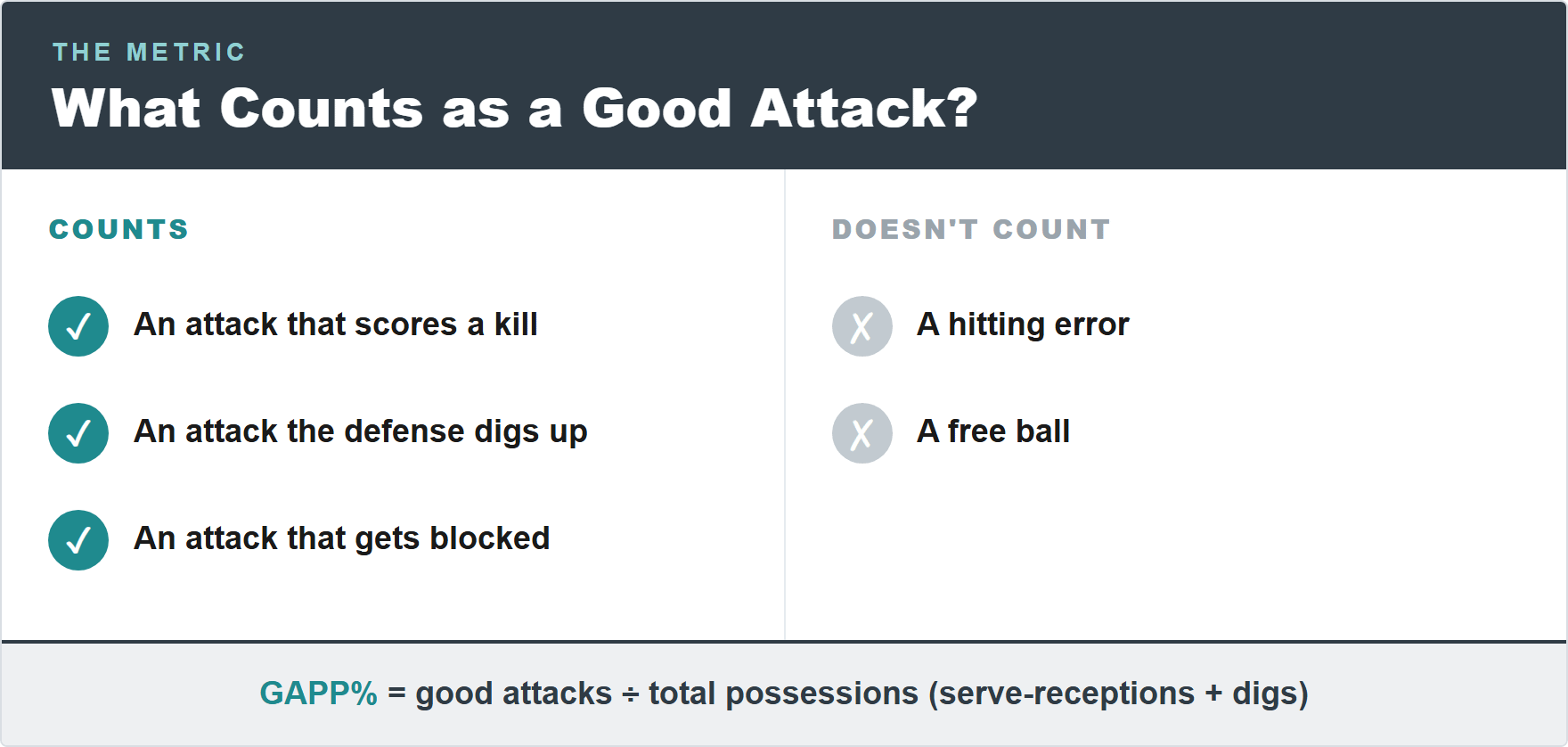
The formula is easy enough to track on a white board during practice. Count your possessions. Count how many you turned into an attack of any kind that didn't go in the net or out of bounds. Divide. That is your GAPP%.
I love this metric because it's a powerful predictor of winning (as we'll see below), it's simple to explain and everyone on the team can easily understand how they can contribute to improving it:
Passers, by passing a few more settable balls
Defenders, by digging up a few more balls that lead to transition attacks
Blockers, by getting a few more block touches that make the ball easier to dig
Setters, by delivering a few more hittable sets
Non-setters, by being ready to set a few hittable balls when the setter can't
Attackers, by attacking aggressively & avoiding a few more unforced errors
Nobody is a bystander.
Coaching takeaway: GAPP% gives you one simple, easy to track metric that sets the frame for every possession: "Can we turn this into a good attack?"
Does it actually predict winning?
While the simplicity of this metric is appealing, it's really only worth using if it actually correlates strongly with winning, and the data shows it definitely is!
I ran the correlation between GAPP% and the percentage of sets won (i.e. Set_Win%) for every NCAA DI Women's team in the 2025 season. The relationship is strong and statistically significant. Across 349 teams, GAPP% and set win rate move together with a correlation of r = 0.775 (p < 0.001).
And unlike a few other metrics which don't hold up well when the level of play goes up, this one is very stable. When you consider only matches between Power 4 teams, the correlation holds up really well (r = 0.733, p < 0.001) and when you look at only matches between teams in the top 50 RPI, the correlation is still strong (r = .661, p < 0.001).
Even when the talent gap narrows, GAPP% keeps sorting the contenders from the pack.
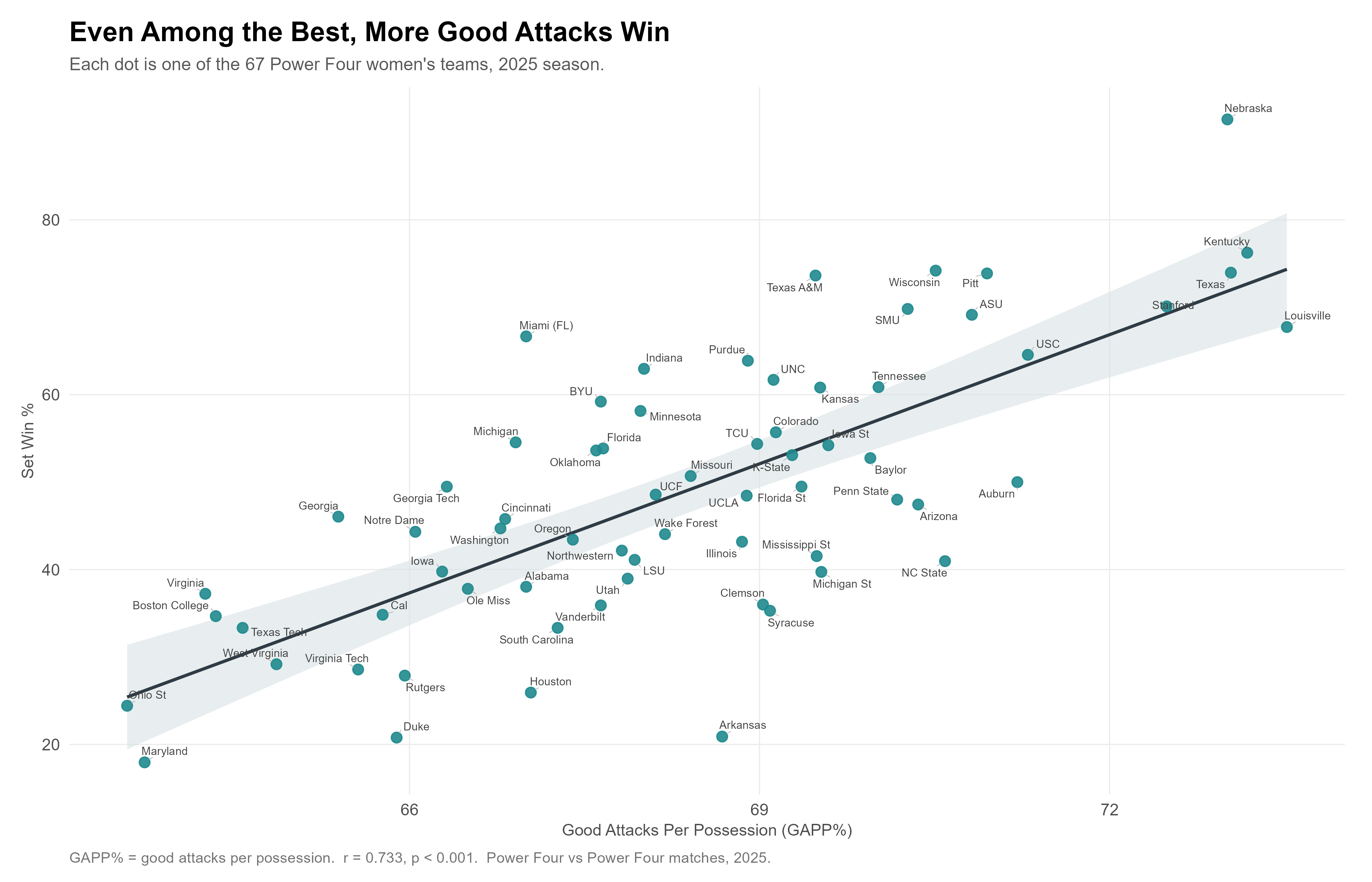
And the relationship here is very straightforward. There is no threshold where the metric suddenly stops mattering, and no point where it flattens out. From the bottom of Division I to the very top, more good attacks per possession keep turning into more sets won.
Coaching takeaway: Because the relationship holds across the entire range, any team can benefit from improving their GAPP%. Wherever your team sits today, improving GAPP% is highly likely to help you win more sets.
The men's game shows it even more clearly
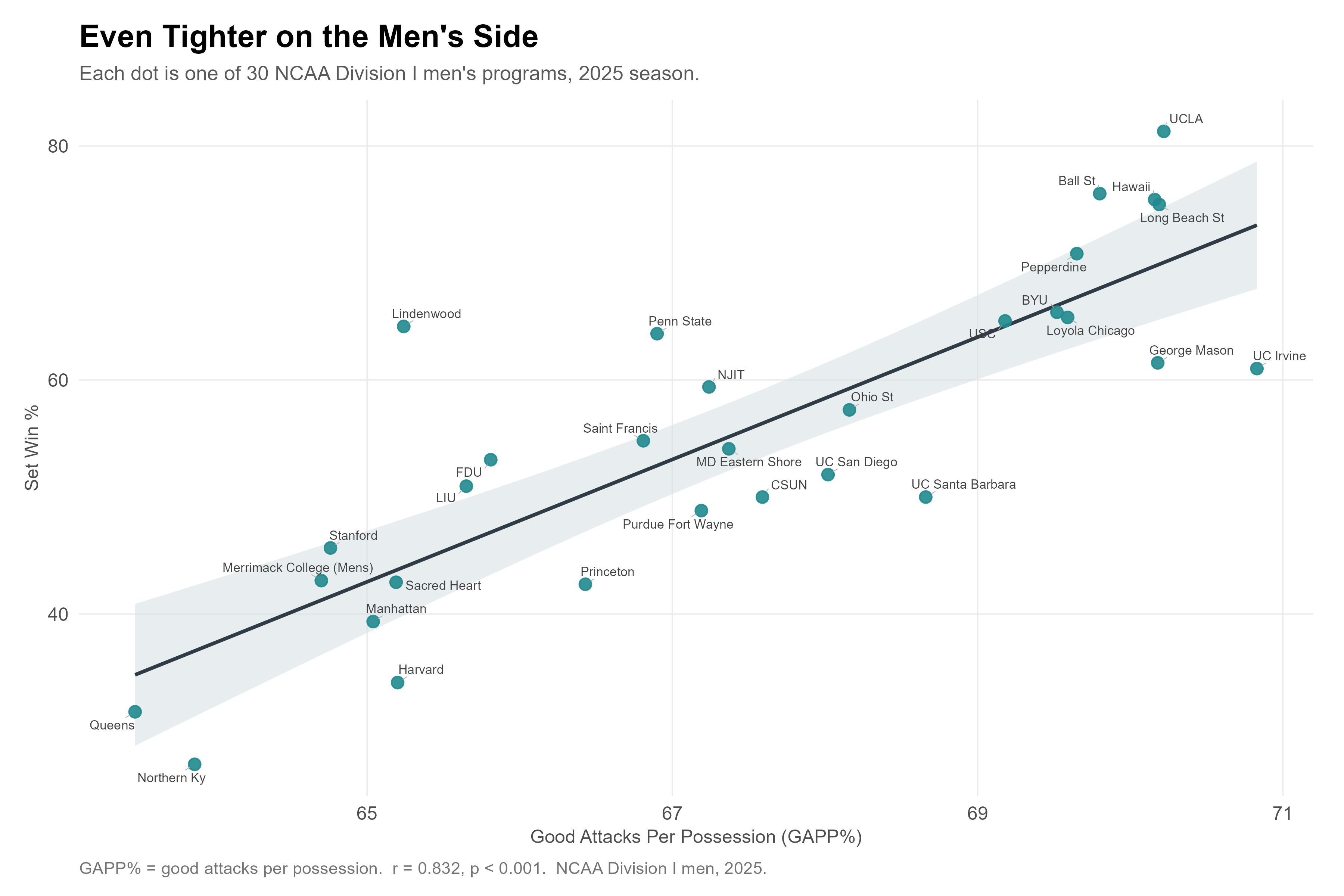
And this isn't just true in the women's game. In fact, it's an even stronger predictor in DI Men's Volleyball.
Across the 30 NCAA Division I men's programs, GAPP% and set win rate move together at r = 0.832 (p < 0.001), the strongest correlation of any group I looked at. With only 30 teams on the chart, you can read it like a leaderboard, from UCLA up in the top right to the programs at the bottom of the standings in the bottom left.
What is a good number?
Here is where it gets practical. GAPP% lives in a surprisingly narrow band. Across all of Division I the average is about 67, and every DI women's and men's team falls somewhere between 63 and 73. That tight range is exactly why small gains matter so much.
To make it concrete, here is where all 349 Division I women's teams landed last season, with four landmarks marked.
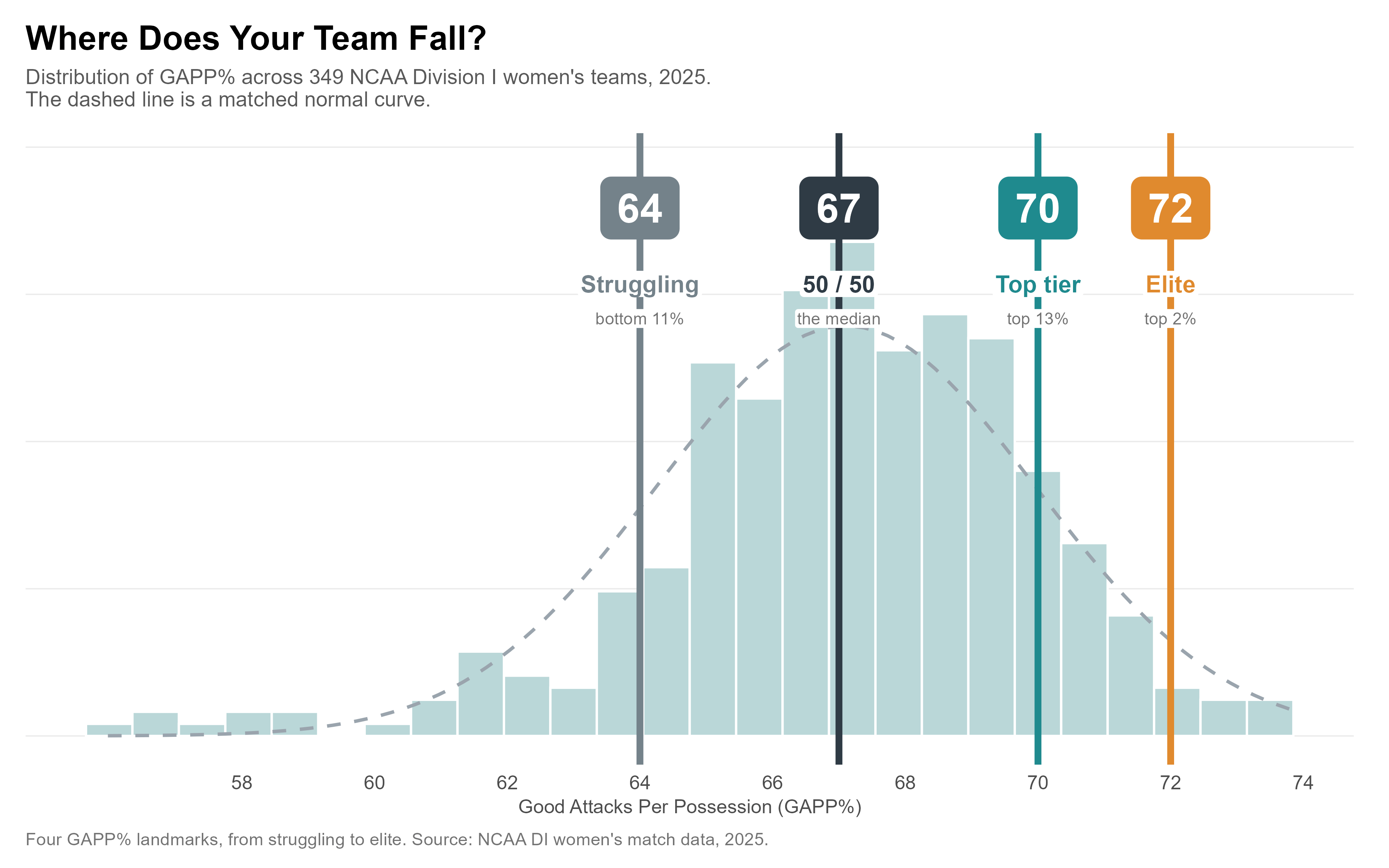
A few landmarks worth knowing. The break-even point, where a team wins about half its sets, sits right at the Division I median of roughly 67. To win 60% of your sets you are generally looking at about 70. The 2025 Final Four teams all had an outstanding GAPP%:
Texas A&M: 70.0%
Wisconsin: 71.1%
Pitt: 71.2%
Kentucky: 73.8%
If you are a regular reader of my blogs, this fits in nicely with what we've learned from previous blogs. To win the NCAA Tournament, you have to be really good at everything (GAPP% included) and you have to have an elite kill% (which Texas A&M did).
For the men's side, the numbers are remarkably similar though the very top of the scale is compressed:
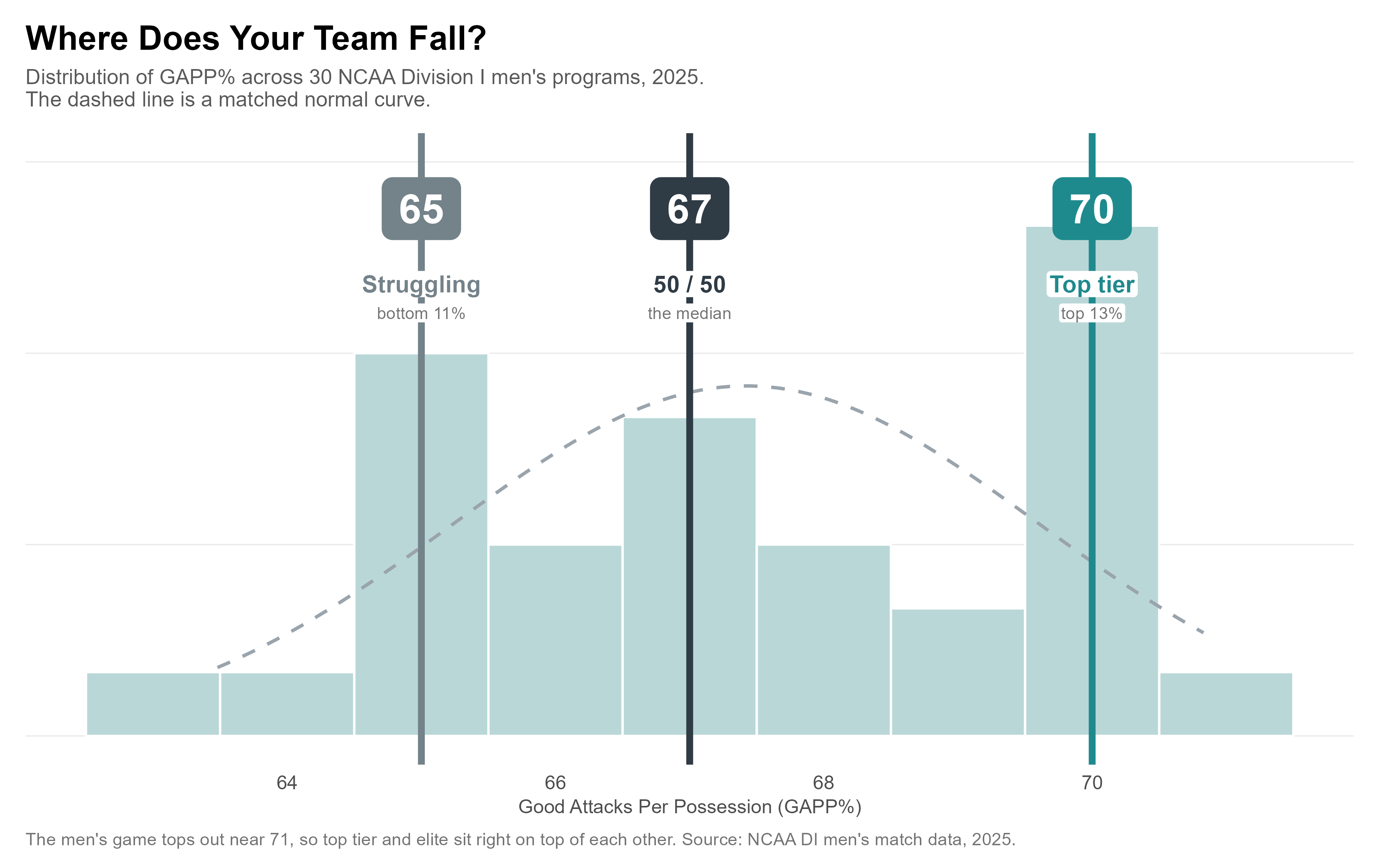
Struggling/bottom 11%: 65%
50/50 (median): 67%
Top tier (top 13%): 70%
Elite (top 2%): 70.5% (not shown above)
Coaching takeaway: Pick the tier just above where you are now and make it the season target. Moving from a 67 to a 70 does not sound dramatic, but on this scale, it is the difference between break-even and a winning record.
The payoff: one point is worth about four
If you coach a Division I women's team, you could reasonably expect that each one-point gain in Good Attacks Per Possession brings about a four-point gain in your set win rate. And if you coach a Division I men's team, the payoff might be even bigger, as high as five points of set win rate for every point of GAPP%.
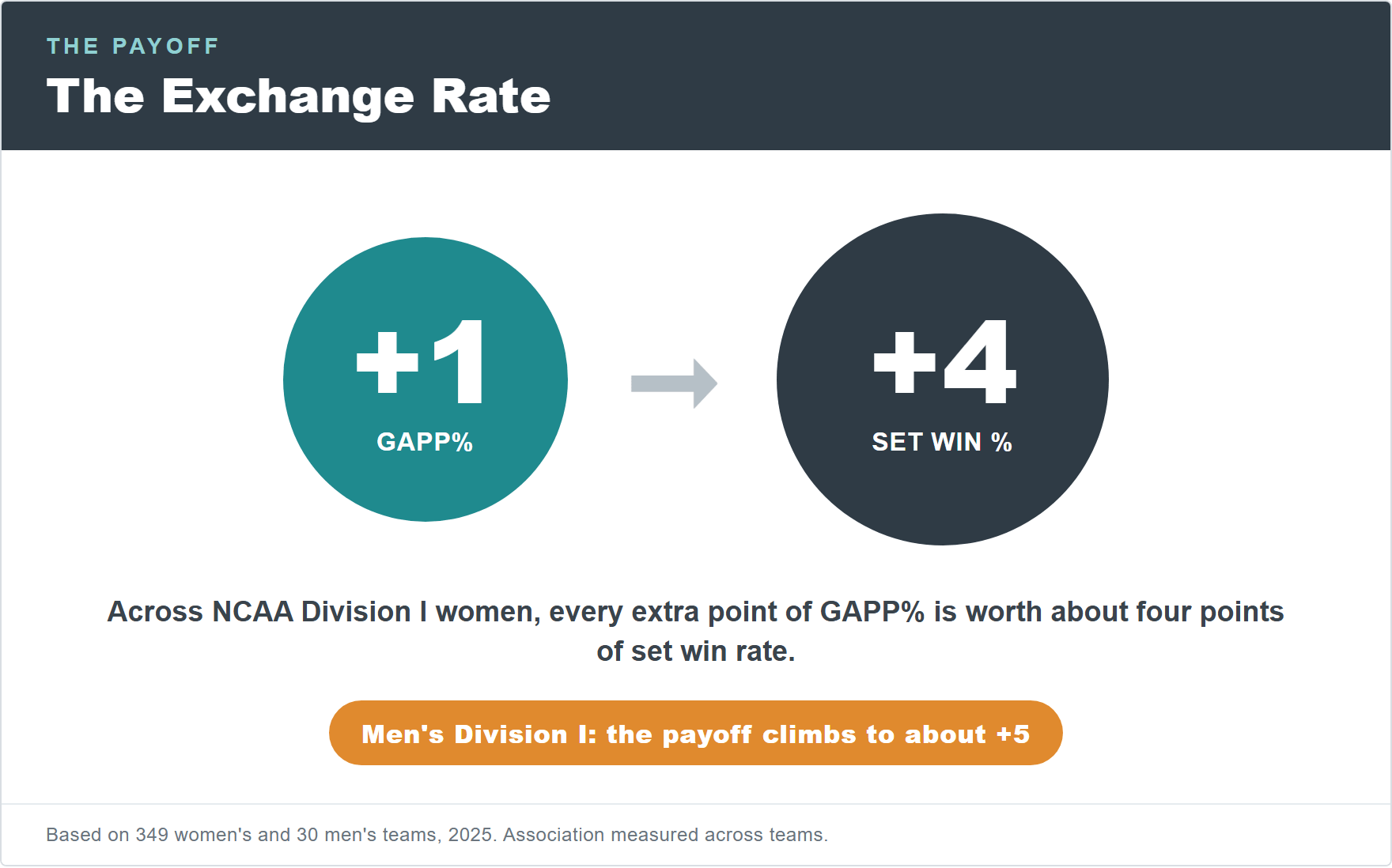
Let that sink in. Making a relatively small improvement in GAPP% (1pp) leads to an outsized gain in Set_Win% (4pp). All you have to do is find a way to trim a handful of hitting errors per set. Or turn a few free balls into real swings. Pass a touch cleaner so your hitters get a few more hittable sets. None of that requires a recruiting miracle. It just requires a team that decides to focus on getting a good attack off as frequently as possible.
That is the whole pitch. One number. Easy to track on the bench, easy to explain in a timeout, and every kid on your roster owns a piece of it.
I used it with my U15 club team at practice on Tuesday. Over three sets to 25, playing pretty clean volleyball (for U15), our average GAPP% was 63.6%, which is right about what you'd expect for this level. I tracked it on the white board (photo below). I definitely find it’s a useful tool! As a coach it helped me focus my attention and feedback, plus it gave the players an easy way to quickly assess how they were doing between sets.
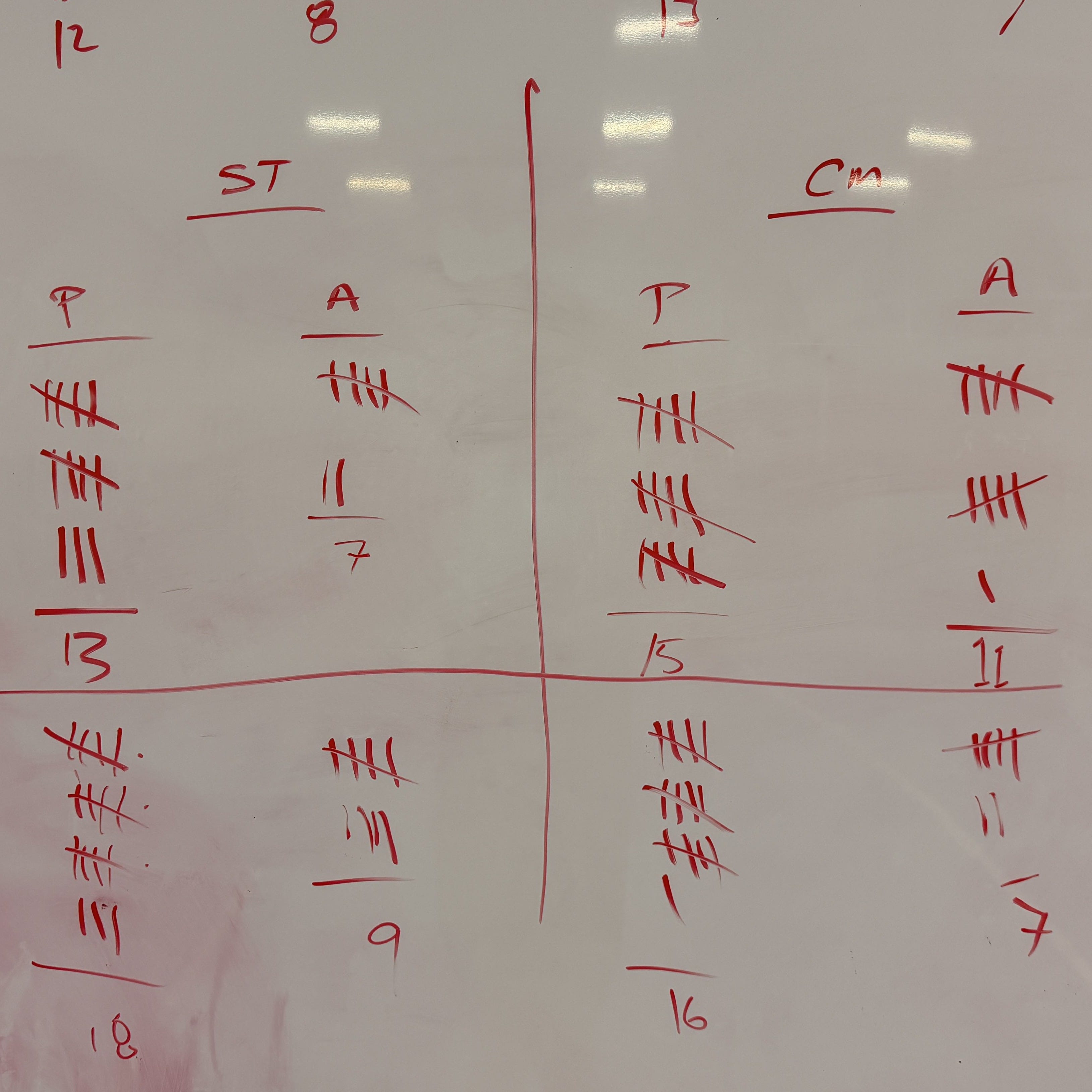
And it was a fun reality check. A good night of U15 volleyball landed right around the bottom of DI. 🙂 I'll keep you posted as I learn more!
Hopefully you’ll give this new metric a try. Let me know if you do and if you find it as useful (or not!). And of course, as always, if you have any suggestions or feedback, hit me up in the comments or email me at alex_simons@hotmail.com
See you in the gym!
Alex
Curious, do you consider plays that don't result in a potential attack for your side as part of your "possession" metric? I.e. shanked passes, setter errors, etc. In other words, if you shank a serve, that's one (wasted) possession that did not result in a good attack, and would therefore be 0% on one attempt?
good stuff! i saw lauren speak at convention as well (probably the same talk), and wondered how we could track this in our gym. thanks for sharing, we will use this for sure!