Digging into the BIC
Part 11 in the "What Really Wins Sets" Series

Howdy folks!
Today's post is a quick one diving into an area I've been thinking a lot about, the BIC attack. One of the things that really surprised me in my last blog was that the top Power 4 women's teams run the BIC just about as frequently as the top men's programs. This is certainly NOT the conventional wisdom in the volleyball community.
So I decided to drill in and see what all I can learn about the BIC from a statistical point of view. Who runs it, who runs it well, where are the best locations to run it from, and which locations on the opponent side are the most effective to attack? Let's dig in!
A quick word on the data. For the men I used the full 2026 NCAA DI men's season. For the women I used 2025 Power 4 teams, filtered to matches where both teams are Power 4. This mirrors the approach I took in my last post.
The Top Line Numbers
Let's start with the headline. As we learned last time, the average men's DI BIC hitter has a higher attack efficiency than the average Women's Power 4 BIC hitter.
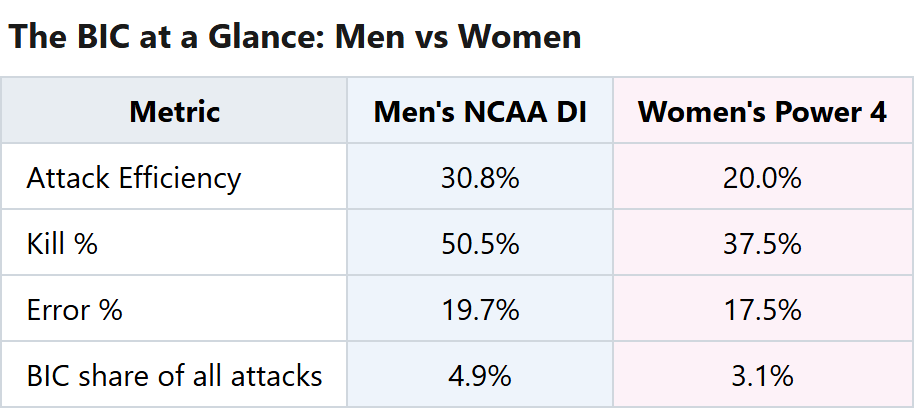
That 10.8-point efficiency gap (30.8% for men, 20.0% for women) is one of the larger efficiency gaps. Interestingly, most of the gap comes from the kill %. Men and women have pretty similar error rates (19.7% for men, 17.5% for women) with the women a little better. But the kill rate gap is a 13-point spread (50.5% vs 37.5%).
My assumption is that this is because the men just hit the ball harder making it more difficult to block or dig.
The men also run it more. The BIC accounts for 4.9% of all men's attacks versus 3.1% for the women, so the men use it 58% more relative to their total offense, but as we'll see, the difference there almost disappears when you look at the top teams.
Who Runs It, and Who Runs It Well
Here are the top 10 programs by BIC%, the share of all their attacks that go to the BIC.
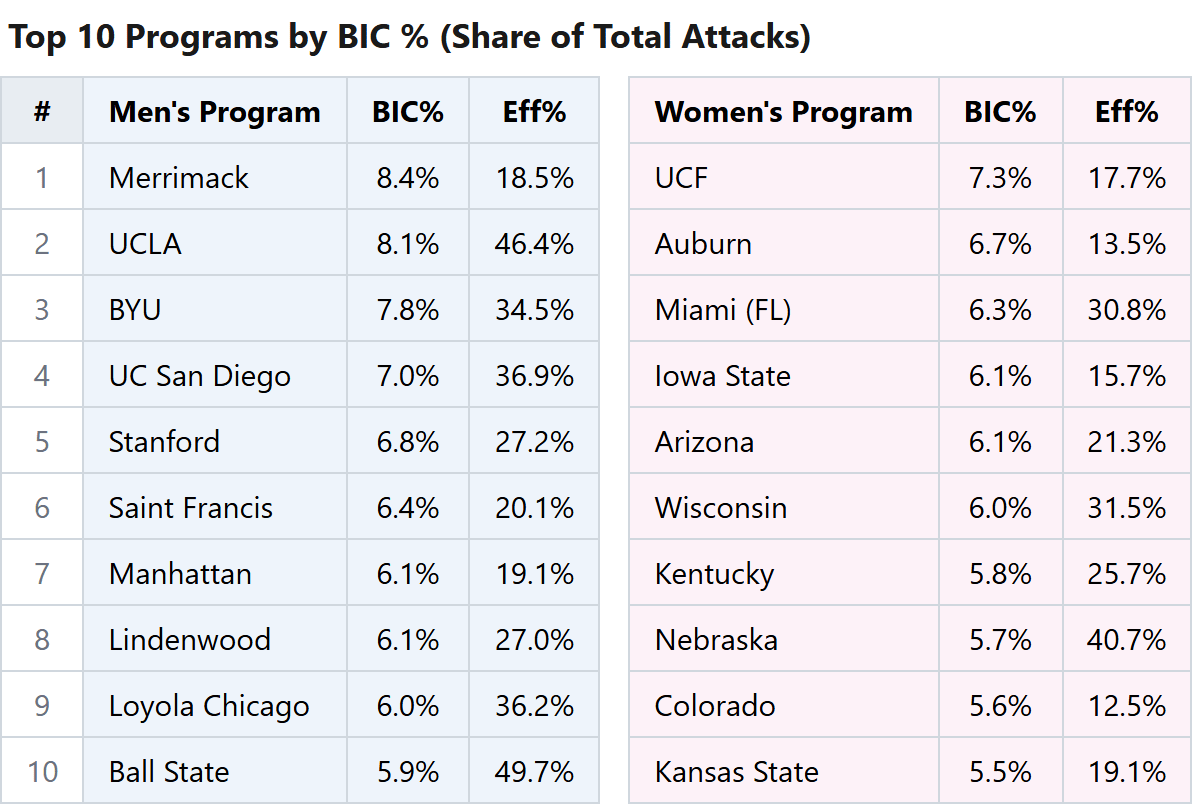
A fun thing jumps out right away: running the BIC frequently is not the same as running it well. Merrimack devotes a bigger share of its offense to the BIC than any men's team (8.4% of all attacks) but converts at just 18.5%. UCF tops the women at 7.3% and a matching 17.7%.
But then look at UCLA! Second highest BIC% in Men's DI and crushing it at 46.4% attack effectiveness. On the women's side, Miami pairs a hefty 6.3% share with a strong 30.8% and Nebraska at 5.7% and 40.7%. I suspect lots of men's teams would love to run the BIC that well.
Now the efficiency leaders, with a 50-attempt minimum (to avoid getting mislead by small sample sizes).
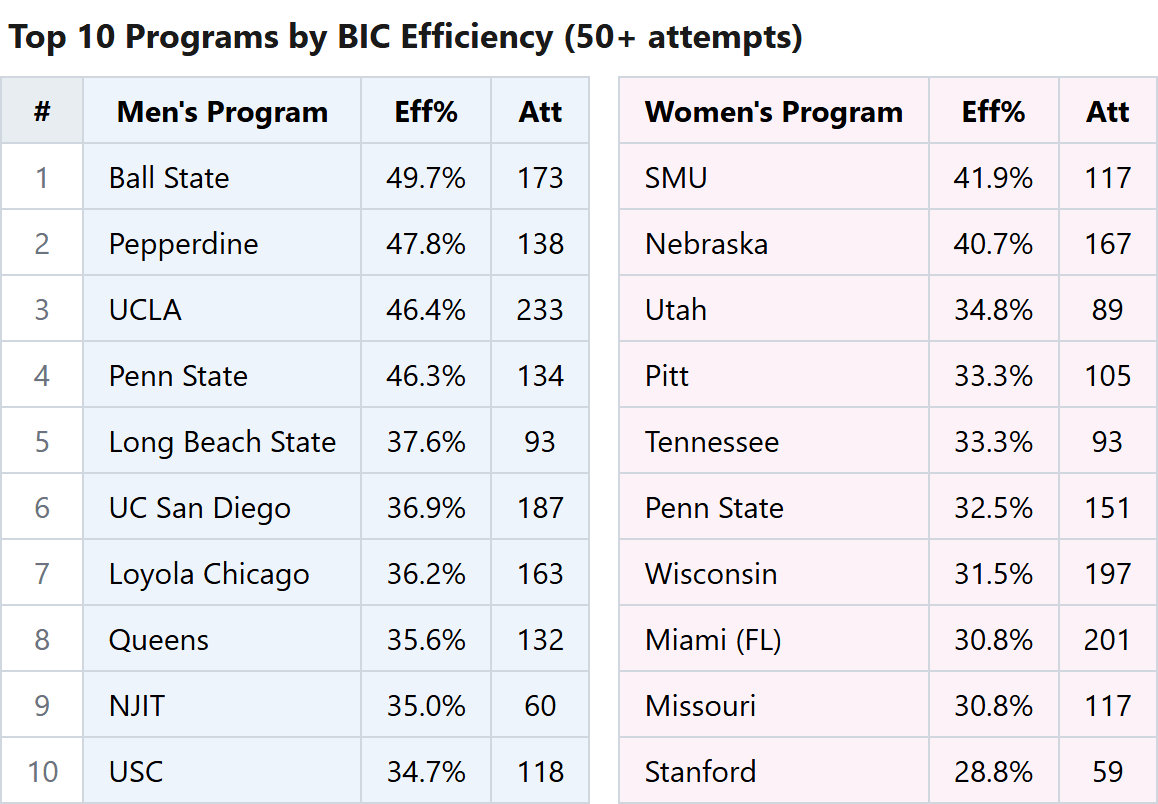
Ball State leads the men at 49.7% (😮)! But scan over to the women's column and notice SMU (41.9%) and again, Nebraska (40.7%). Those two numbers would slot into the men's top five, ahead of every men's program outside the top four. The very best women's BIC teams are right there with elite men's offenses.
Coaching takeaway: If you want a model for the BIC in the women's game, study SMU and Nebraska. They prove the play can be a primary, efficient weapon rather than a niche play.
When Do Teams Run It?
We know who runs the BIC and who runs it well. The next question I had is which rotations they run it in, and this turned out to be my favorite finding of the whole exercise.
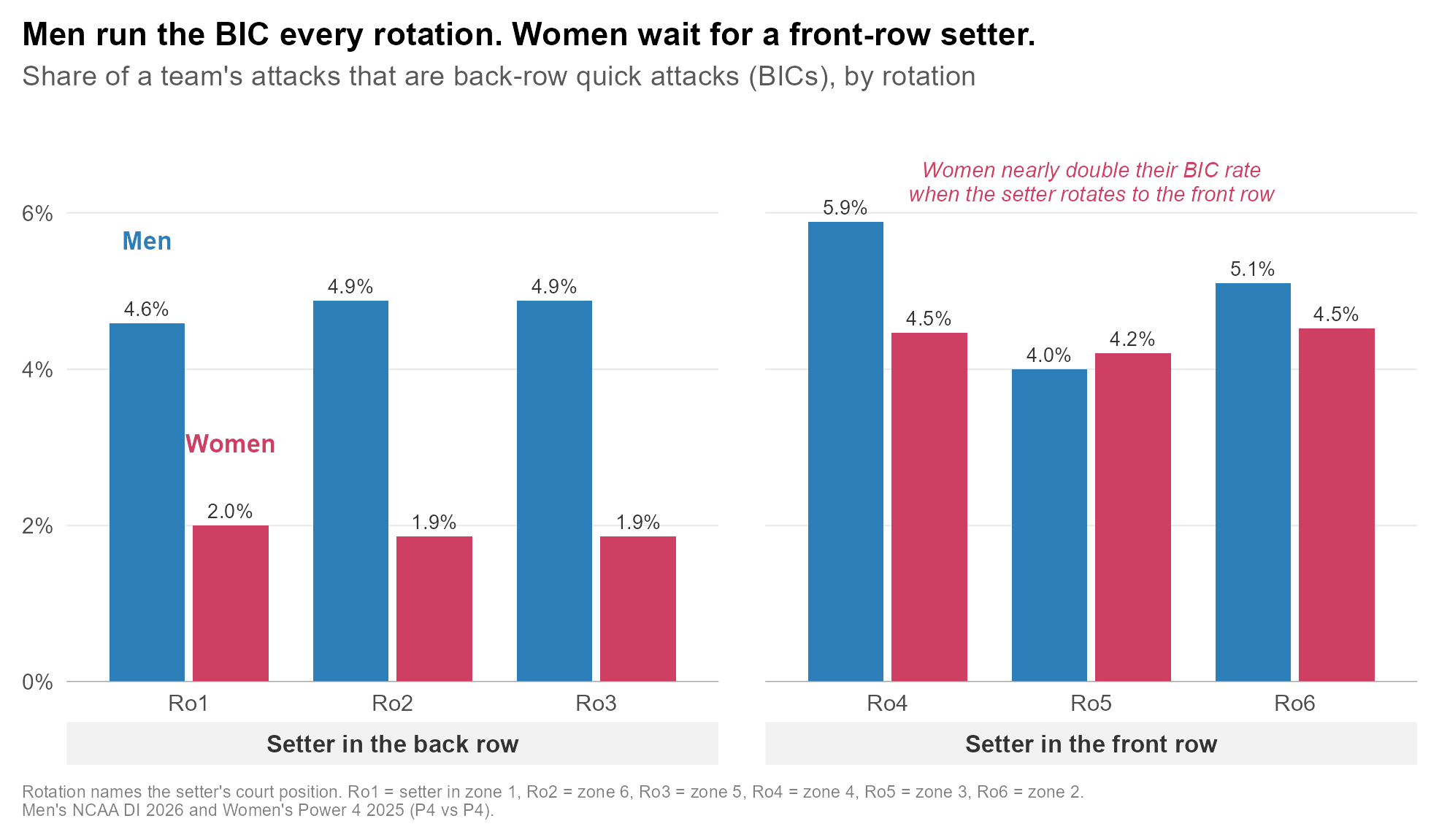
Look at the women's bars on the left side of the chart. When the setter is in the back row, Power 4 women's teams rarely run the BIC, right around 1.9 to 2.0% of their attacks. But when the setter rotates to the front row, the rate more than doubles to roughly 4.5%. This would seem to say that most women's teams are using the BIC to add a third attacking option when their setter is front row.
But the men's data tell a different story. Their BIC% is relatively similar in every rotation, between 4.0 and 5.9% across the board. Men's teams run the BIC whether the setter is in the front row or the back row.
I think this is because of the D-ball and how it’s used in men’s volleyball.
As we learned in my last blog post, men's teams love to run the D-ball, so when their setter is front row, they already have a third attacking option. What we're seeing here is that in the men's game, the BIC is used to create a 4th attacking option in every rotation by having both outsides hit BICs.
Coaching takeaway: I think the men have it right here - If you aren't using the BIC in all six rotations, you are taking a really effective weapon off the table. For my U15 girls’ teams, we run a BIC in every rotation and since we usually run a 6-2, we always have 4 attacking option. The next time your setter is in the back row, take a look to see if you can find ways to get your backrow OH available to attack!
Where to Hit It From
And now for the geeky part. I was talking with Jonathan Winter, the head coach for the Pepperdine Men's team this week. He asked if I had any data about which locations/route were the most effective for hitting a BIC.
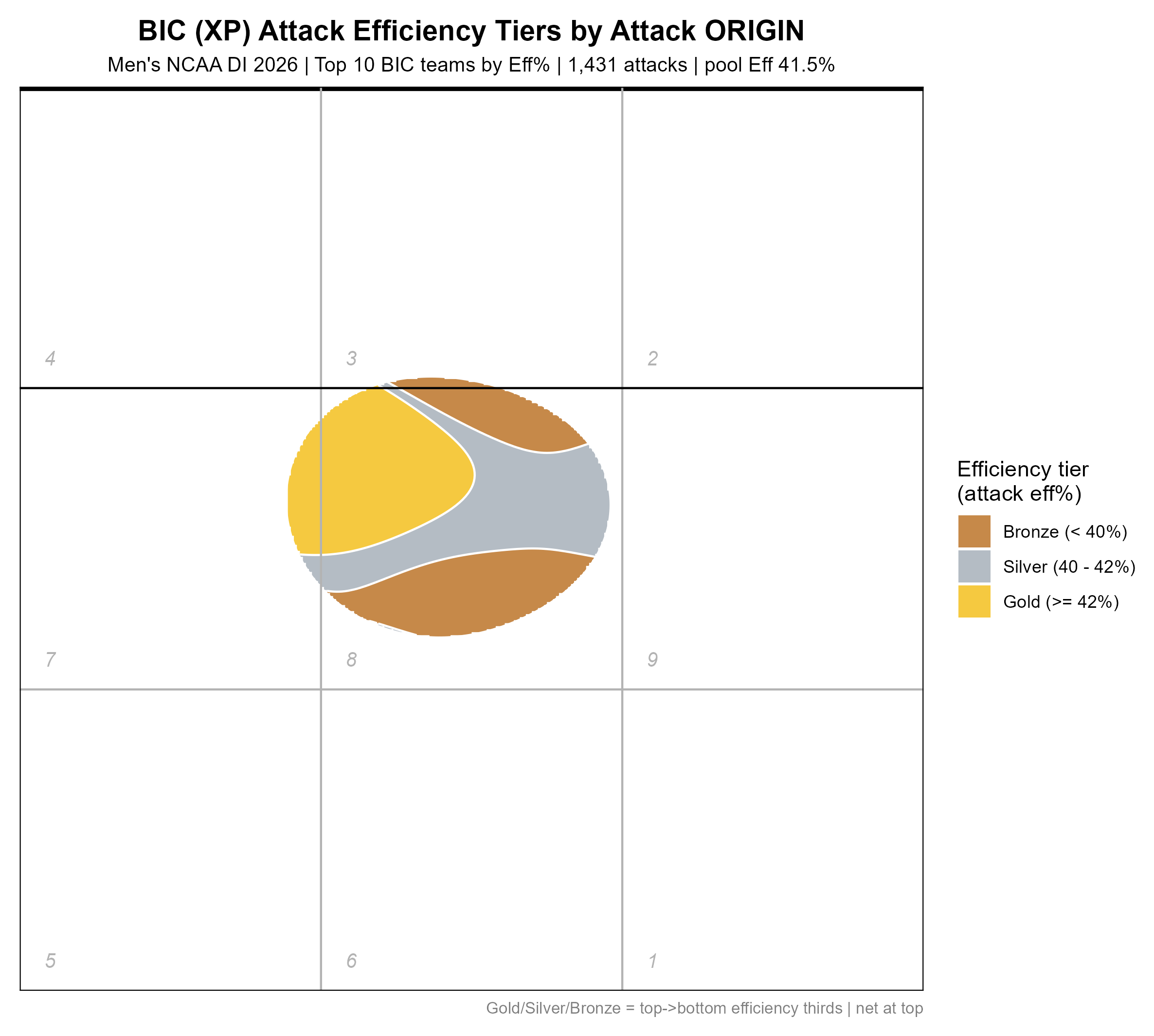
To answer that question, I took the top 10 BIC programs by efficiency in each pool (we are looking at how the best of the best do it) and split each map into three efficiency tiers. Gold marks the most efficient third, silver the middle, and bronze the least. The legend on each map lists the actual attack efficiency range for every tier.
First, here's the attack from location heatmap for the top 10 men’s teams:
And here's the same for the women's side:
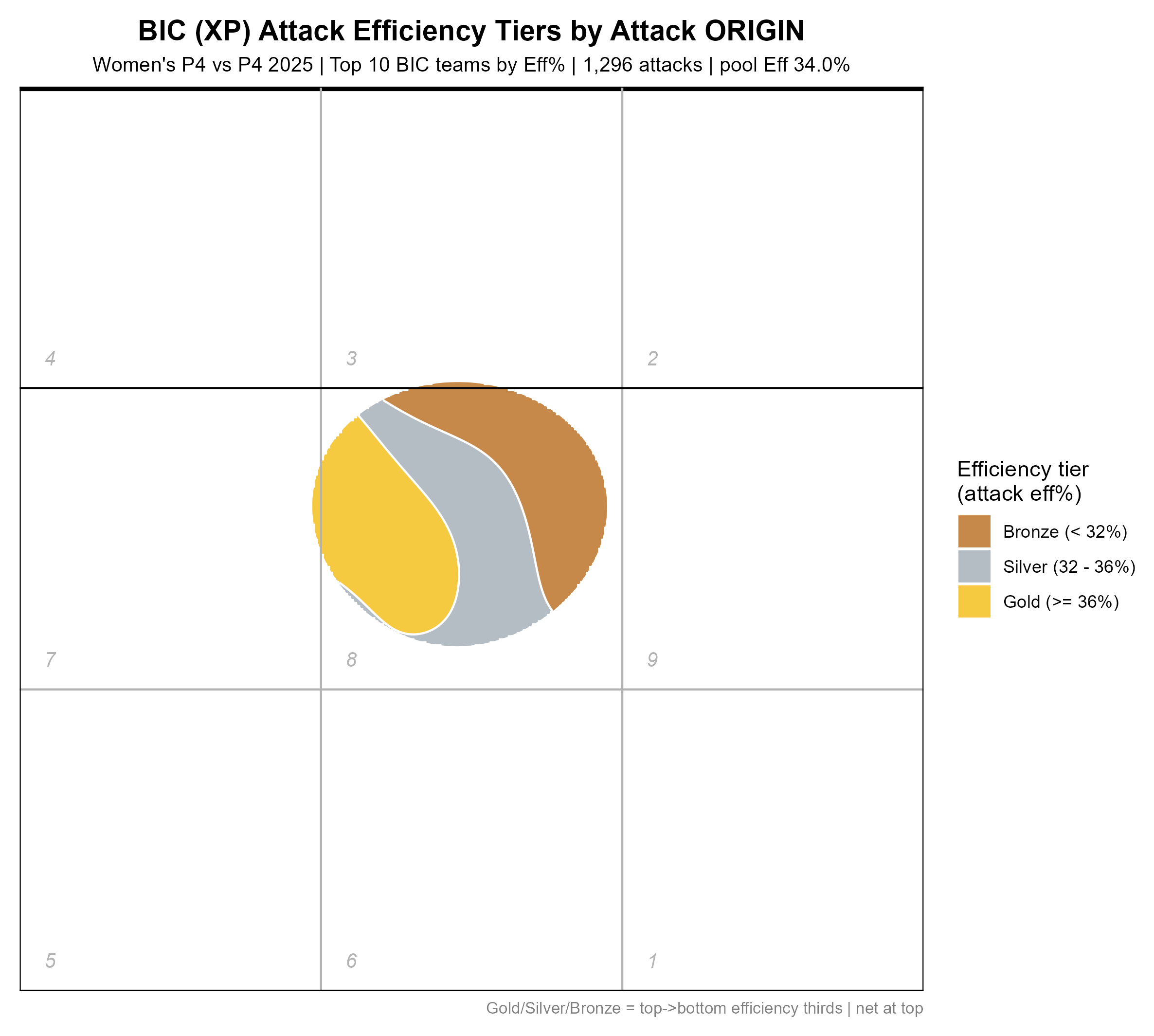
Remarkably similar! The gold zone is in the front left of zone 8 for both. This area is where you would attack if you were running what many of us call a "flare" route. The BIC is most efficient when it is contacted left of center, and it drops to bronze as the contact point slides to the right.
Coaching takeaway: Shade the BIC slightly left of dead center as often as possible and have your hitters run a flare route.
Where to Attack to
Finally, which locations on the opponent’s side are the best to attack based on attack efficiency? These maps show efficiency by landing spot on the opponent's court, with the net at the top.
Important Note about these heatmaps. This data shows, when BIC attack ends up in this location, the likelihood of the result being a kill. And importantly, this does not include any attacks that were blocked or attacking errors (they didn't make it to this spot) or had block touches (since we don't know where those were meant to go).
First the men's heatmap:
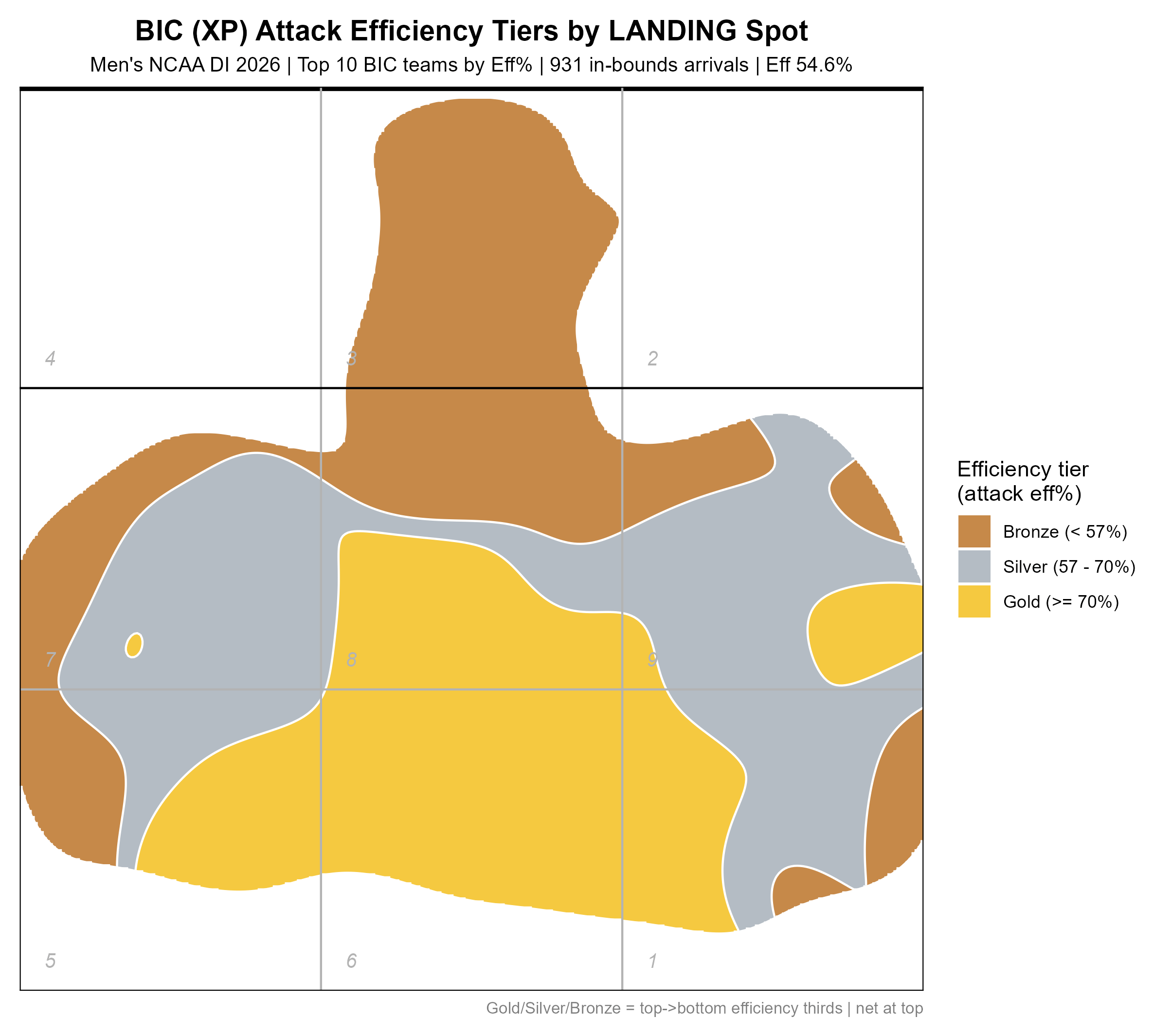
The interesting thing here is that clearly the best place to hit a BIC in men's volleyball is the last half of the court, in the middle. And tipping over the block? Not nearly as effective.
And now the women's heatmap:
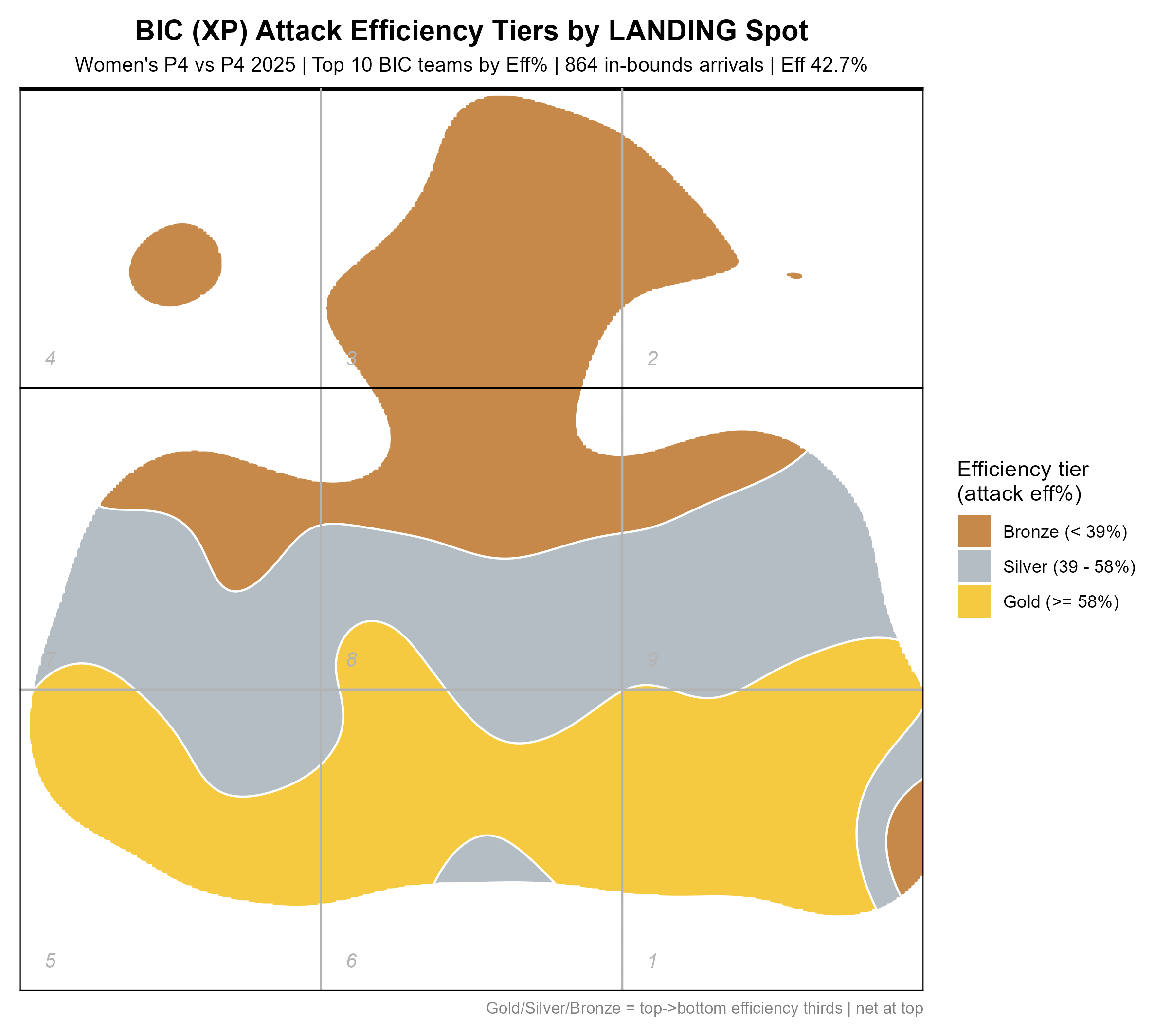
This one is notably different! The middle of the court is not a great target here - the biggest gold areas are clustered deeper in the court to the left and right of middle back.
David Hunt, the Associate Head Coach for the Women's team at Texas and I were discussing BICs this week. His take (which this data seems to support) is that in the men's game, the BIC hitters hit it hard enough to overpower the backrow defender whereas in the women's game, it's about the speed of attack and getting the ball on the ground in the corners faster than the defender can get there.
Coaching takeaway: If you are coaching men to hit BICs, they need to focus on hitting it hard to the middle/middle back third of the court. If you are coaching women to hit BICs, they need to focus on hitting more for the deep corners/seams of the court to be effective.
Wrapping Up
The BIC has become one of my favorite parts of the men's and women's game and as someone who has always coached women's teams, I was pretty excited to see that in many cases, the women are hitting BICs just as frequently and just as effectively as the men's teams. That's very cool to see!
Hopefully you will find these new heatmaps as useful as I did. I reviewed these and a few other new ones with my team on Tuesday before practice and they were already adjusting their attacking routes and locations by the time we finished up that night.
Wishing you all similar success with your teams!
As always, if you have any feedback, suggestions or questions, please hit me up in the comments or send me an email at: alex_simons@hotmail.com
See you on the court!
Alex
Am I right in thinking that the data set you are using is generated by Volleymetrics?